By: Jasmin Mujanović
Restoration and Preservation: Reflections on the Bosniak Assembly of 1993
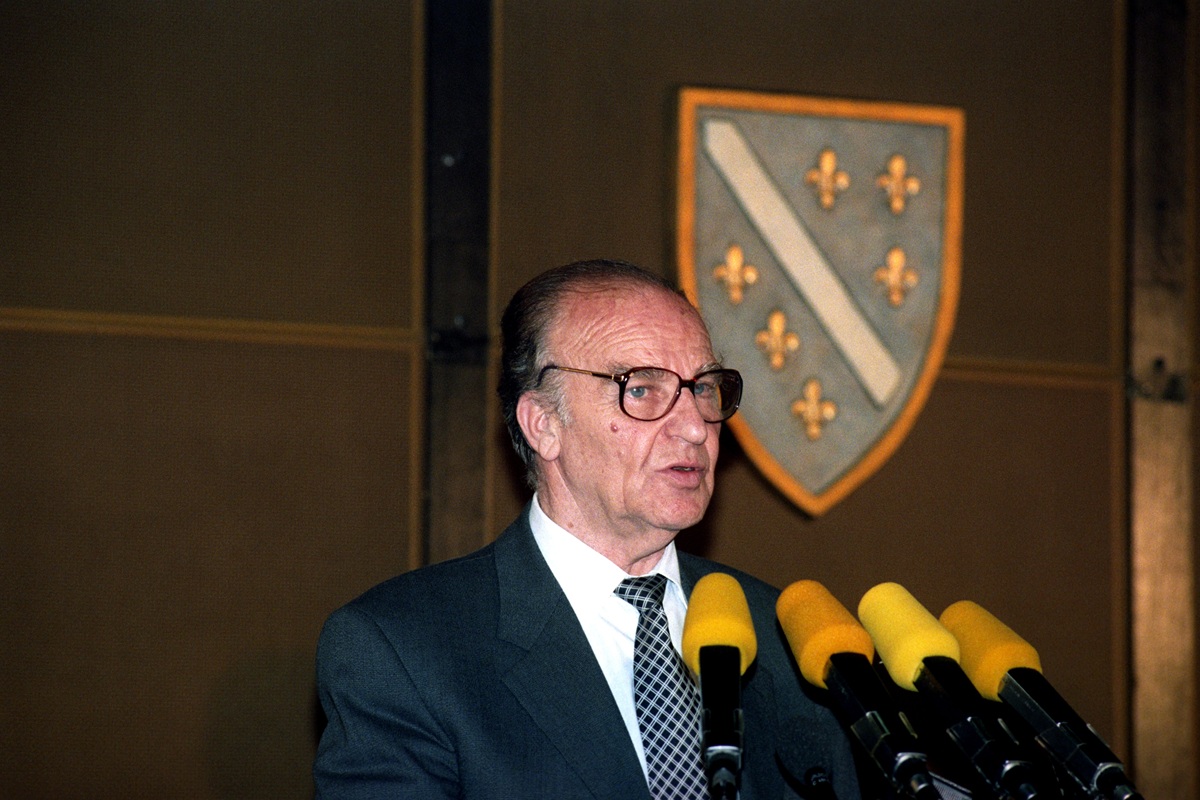
Alija Izetbegović na Bošnjačkom saboru 1993. (Foto: EPA)
Jasmin Mujanović
27.09.2025. 03:38
The history of Bosnia and Herzegovina is little known, even among Bosnians themselves. That phenomenon is, unfortunately, especially pronounced among the Bosniak community. In fact, among large segments of the Bosniak community their own self-conception – the basis of their identity and their relationship with the state of Bosnia and Herzegovina - is still too often shaped by the shibboleths imposed on to them from without.
Take as an example only the ritualized debates about whether the Bosniak nation should “look to the west” or “look to the east” to assert their historical legitimacy. Glaringly absent in this dichotomy is the actual source of Bosniak national identity; that they are an indigenous Bosnian people of the historic Bosnian lands, and the recipients and carriers of the culture, language, and community which has been fostered therein. The Bosniaks may be predominantly Muslim, and their community may also be European. But they are a nation because of their indigeneity in Bosnia and Herzegovina, and their continued commitment to Bosnia and Herzegovina as a politically and culturally sovereign subject.
This basic, factual assertion, however, remains deeply contentious, even among segments of the Bosniak community. Why? Because influential political and intellectual currents within the Bosniak community oppose the idea of a Bosniak nation. Why? Because they have inherited a sense of self that is not their own. Despite belonging to, originating in, and inhabiting a political-cultural milieu that is categorically Bosniak, that reflects the existence, historicity, and sovereignty of the Bosniak nation, these individuals reject these material realities in favor of opposing historiographies. Specifically, those which, to one extent or another, characterize the Bosniak nation as either artificial, novel, or even reactionary.
Because such claims are demonstrably false and have as their singular purpose the continued political subjugation of the Bosniak people adherents must either amend their views (i.e. rejoin the complex, pluralist Bosniak national tradition) or, literally, exit the community. Not because they are driven out; the Bosniak public is far and away the most liberal and tolerant in the whole of Southeastern Europe. Instead, it has been the practice of Bosniak intellectuals and artists who oppose the Bosniak national project to exile themselves. Such has been the sad fate of a particular sort of erstwhile Bosniak intellectual since the 19th century. Those who are unable or unwilling to liberate themselves from the ideological blinders imposed on them by the succession of regimes which have sought to dominate Bosnia and Herzegovina and to ultimately assimilate, subjugate, or exterminate the Bosniak nation.
This is the broader socio-historical context in which one must reflect on the events of the Bosniak Assembly of September 1993, perhaps the most significant ideological manifestation in the modern history of the Bosniak nation and Bosnia and Herzegovina as a sovereign state. Because two significant developments occurred at that Assembly, made still more extraordinary by the context in which they occurred: a moment of existential threat to the survival of the Bosniak people and their homeland as a sovereign state.
First, the Assembly restored the historic name of the Bosniak people and asserted categorically their right to nationhood. By stressing that it was, indeed, an act of restoration, not the adoption of a new moniker, the Assembly demonstrated the agency of the Bosniak nation and its intelligentsia, and their recognition of the need to reclaim their own history. The term “Bosnian Muslim(s)” while not necessarily offensive, was nevertheless a product of political pressure and censorship by both the royalist and communist authorities. And it was, above all, deliberately nonsensical, melding religious and national identity for the explicit purpose of denigrating the proliferation of the latter among the Bosniak community.
Second, the Bosniak Assembly was convened to deliver a collective decision on the Owen–Stoltenberg peace plan, which proposed re-organizing the Republic of Bosnia and Herzegovina into a “union of [three ethnic] republics”. There was small but influential cohort of those gathered in Sarajevo who believed that the plan should be accepted. Both because the then situation on the front facing the Army of the Republic of Bosnia and Herzegovina was dire, and because they were enamored with the idea of an exclusively “Bosniak republic”. The vast majority of the delegates rejected the plan, however, and, more importantly, rejected the idea of a partitioning Bosnia and Herzegovina along exclusively ethnic lines.

That two-fold rejection was a moment of historic agency.
It signified the willingness of the Bosniak political and intellectual leadership to persevere with their own autochthonous, ideological program in the face of overwhelming odds. And the odds were indeed overwhelming. Rejecting the Owen–Stoltenberg plan meant opposing both Serb and Croat nationalist militants, and the international community, which then still saw the broader Bosnian independence cause as, at best, a doomed initiative. As such, capitulation and acquiescence may even have been the more “logical” course in the autumn of 1993. But to do so would have undermined the preservation of Bosnia and Herzegovina within its historic borders, and the survival of the Bosniak nation within all its ancestral lands.
Today it is fashionable to mischaracterize the eventual Dayton Agreement as itself a form of surrender by the then leadership in Sarajevo and the broader Bosniak political establishment; as little different, perhaps even worse than the Owen–Stoltenberg plan. But comparing what was on offer in 1993 and what was achieved at Dayton in 1995 demonstrates the absurdity of such claims, and the significance of the unity and courage shown during the Bosniak Assembly.
The Dayton Agreement affirmed both the sovereignty of Bosnia and Herzegovina, and that legal continuation of its statehood under its provisions, and thus no new state(s) were created at Dayton. The entities (and cantons which had previously been established through the 1994 Washington Agreement, i.e. the defeat of the para-criminal Herceg-Bosna regime) were merely “modifications” of the internal administration of the country. Thus, despite the use of the term “Republika” in the name of the smaller entity after 1995, within the constitutional order of the Bosnian state after Dayton neither the entities nor the cantons were in any sense sovereign. Nor was the Bosnian state created or constituted through their union. It existed independently of both, and in the event of any future constitutional crisis or implosion of the country’s legal order, all their legal-constitutional authority would, in effect, default to the state.
And aside from the obvious territorial advantages secured at Dayton by the Sarajevo leadership, that is, the Army of the Republic of Bosnia and Herzegovina, as compared to the Owen-Stoltenberg plan – i.e. geographic continuity of territory for Bosniak-majority areas, the inclusion of every major urban center other than Banja Luka in the territory of the Federation entity, the establishment of the Brcko District after 1998 and the de facto partition of the RS entity etc. – the legal provisions of the new constitution were even more important. Article 2.2 of the constitution negotiated at Dayton was a veritable sunset clause to the most severe ethno-sectarian provisions of the broader agreement, as shown by the succession of successful legal challenges against the same sectarian provisions through the Court of Bosnia and Herzegovina and the European Court of Human Rights.
Of course, the Dayton Agreement was not an ideal compact. Its flaws are legion, and constitutional reform must be one of the chief aims of any coherent post-war Bosniak national politics. But it was a markedly better agreement than what the Bosniak and broader Bosnian leadership were offered (threatened, really) with in 1993. That should be apparent in any honest assessment. The more important question is: how was it achieved, and can it be replicated?
The foundations of the deal secured at Dayton, which ensured the continuation of the Bosnian state and thus the continued sovereignty of the Bosniak homeland, were laid at the Bosniak Assembly of 1993. These, in turn, were the result of the recognition by the delegates that the broader Bosnian independence cause depended, first and foremost, on the agency and activation of the Bosniak nation. It was they who needed to assert their national character, without compromise, and to then commit the necessary political and material resources to realizing their national program. Yes, Dayton necessarily involved certain compromises of that national program. But it secured the most categorical objectives of the same and established a clear pathway towards the realization of the program in its entirety. Better still, that pathway could now be political and democratic, rather than dependent on the force of arms.
Most importantly, the conclusions of the Bosniak Assembly required neither the creation of a single party regime nor the rejection of other peoples and nations from Bosnia and Herzegovina. The Bosniak Assembly embraced pluralism because this reflected the lived values and commitments of the Bosniak people themselves. Beset by nationalist extremism on all sides, the delegates of the Bosniak Assembly articulated a confidently moderate agenda because it reflected the inherent truth of their national character: the restoration of the historic markers of the Bosniak community and the preservation of the sovereignty of their homeland.
Every aspect of the program articulated in 1993 at the Bosniak Assembly remains accessible to Bosniak leaders today. But they must find within themselves the courage to act on it.
Dr. Jasmin Mujanović is a Senior Non-Resident Fellow at the New Lines Institute and the author of the books “Hunger and Fury: The Crisis of Democracy in the Balkans” and “The Bosniaks: Nationhood after Genocide”.
O autoru

Jasmin Mujanović
Jasmin Mujanović je bosansko-američki politolog, autor nekoliko knjiga.
Više od istog autora