Why has Sarajevo Safari suddenly become headline material for major Western media outlets? That is the question many Bosniaks are asking today. Why this sudden surge of empathy for Sarajevans—hunted for fun by wealthy western degenerates during the siege—when those same voices remained silent while the Office of the High Representative (OHR), under Christian Schmidt, imposed political apartheid on Bosniaks, a genocide-surviving people, in a degrading manner, through conduct such as publicly yelling at their journalists—adding insult to profound injury
Sarajevo Safari: The Hunter Becomes the Hunted
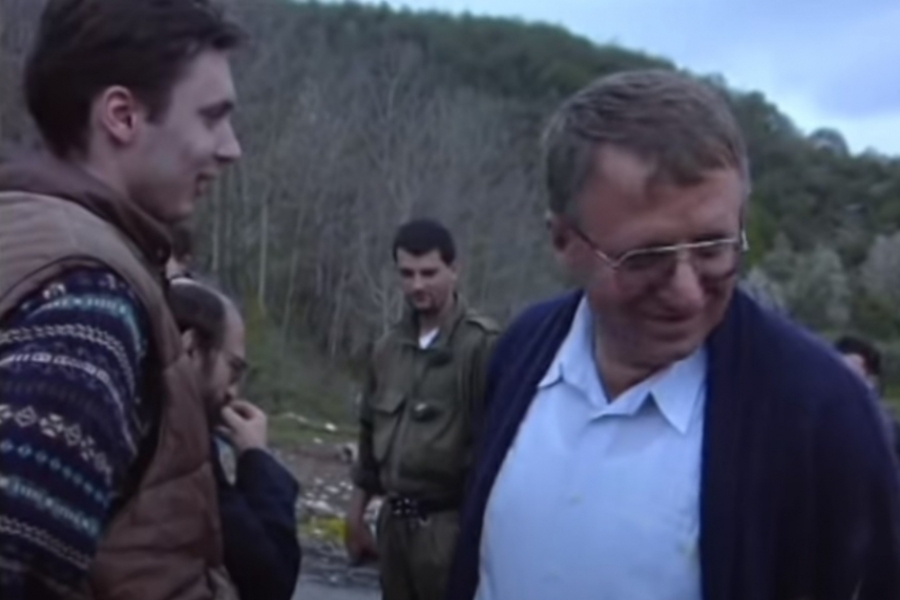
Vučić (left) with his then party leader, Vojislav Šešelj, who would later be convicted of war crimes.
Esad Širbegović
08.12.2025. 13:42
Why is it not news that Srebrenica is still run by the forces that committed genocide?
Or Višegrad, where Bosniak civilians were burned alive in the Omeragić house?
Or countless other towns where the perpetrators of mass atrocities still hold administrative power?
Why is Sarajevo Safari a story, while the ongoing Gaza Safari—a state-sanctioned human hunt financed and armed by Western governments—is treated as routine?
For many in Bosnia, the flood of international news feels alarming. They wonder: is this a warning sign of a new conflict?
The anxiety deepened after reports emerged that Serbian President Aleksandar Vučić was under Italian investigation for alleged links to Sarajevo Safari.
The concern is not Vučić alone, the West's former golden boy in the Balkans. The fear stems from the urgency with which Western governments now appear to be pulling Serbia into their orbit. For many, that haste signals preparation for war—a sign that Bosnia could become the next frontline in the post-Ukraine power struggle between the West and Russia.
Sarajevo Safari and Aleksandar Vučić
The term "Sarajevo Safari" is based on documented accounts of affluent foreign nationals who paid to shoot at civilians during the siege of Sarajevo.
Slovenian filmmaker Miran Zupanič documented it in his 2022 documentary. Based on the film and witnesses, these attacks were launched from Army of Republika Srpska positions overlooking the city.
Reports indicate Bosnian intelligence knew of "Sarajevo Safari" by 1993. Its work with Italy's SISMI broke up a human hunter cell in Trieste a year later, confirming Western agencies were aware of these atrocities by 1993-94.
Spurred by the documentary's evidence, legal action began in Bosnia in 2022 and escalated to an international level with Italy's investigation in 2025.
The case escalated to its highest level yet when Italian prosecutors received a criminal complaint directly implicating Serbian President Aleksandar Vučić. His denial and threat to hire "the world's best lawyers" to sue media outlets ring hollow against the backdrop of his record during the Bosnian Genocide.
Vučić's Bosnian genocidal reputation
Vučić's reputation is already defined by his stance during the Bosnian Genocide, making the "Sarajevo Safari" story almost superfluous. On July 20, 1995, Aleksandar Vučić spoke from the podium of the Serbian Parliament and stated: "Well, go ahead and bomb, kill one Serb, and we will kill one hundred Muslims. Then let's see if the international community, or anyone else, dares to strike Serbian positions. Let's see if anyone can behave that way toward the Serbian people."
In this speech, he threatened the international community—which was considering a bombing campaign to stop the genocide—with a policy of mass murder of Bosniaks directly modeled on Nazi reprisal tactics.
During WWII in the Balkans, Nazi forces implemented a policy of collective punishment, systematically executing 100 local civilians for every one German soldier killed, 50 for wounded.

The Timing Is the Story
The systematic marginalization of Bosniak genocide survivors received scant Western media attention for years, with coverage that was consistently sporadic and indifferent.
Yet now, suddenly, Sarajevo Safari is everywhere.
This story is not new. The facts are the same. Why now, after years of silence during the systematic disenfranchisement of Bosniaks, does this long-documented crime finally provoke outrage?
Across the Balkans, a critical question emerges: Are the Sarajevo Safari files European Epstein files—a vault of names, leverage, and untapped political consequence? The implication of President Vučić ignited the inquiry. If one leader is linked to these atrocities, it raises the terrifying prospect of a wider network, implicating others who have thus far escaped justice.
Because if the outrage is late, the timing is not accidental. So the question now is unavoidable:
Why Vučić—why now?
Is it because he did not deliver to the West what he promised?
The Fall of a Two-Chairs-Sitting Diplomatic Genie
Vučić was expected to deliver Serbia firmly into the Western camp. In return, Belgrade was promised substantial rewards: control over nearly half of Bosnia, the northern part of Kosovo, and EU membership. The EU relied on the classic carrot approach—offering incentives, privileges, and promises of integration to shape his decisions.
Belgrade has long been described as a "diplomatic genius" for its deft policy of "strategic hedging"—a multi-vector strategy that plays both East and West to its advantage. By engaging the European Union, Russia, and China simultaneously without committing fully to any single bloc, Serbia secured geopolitical flexibility and significant economic benefits.
This calculated balancing act was the cornerstone of its strategy: publicly maintaining a commitment to EU integration while refusing to join sanctions against Russia. From this ambiguous stance, Belgrade leveraged its position to extract tangible rewards, including favorable energy deals, foreign investment, and diplomatic support. It applied the same shrewd pragmatism to the Kosovo issue, maintaining dialogue to protect its claims while avoiding isolation.
Ultimately, Serbia has repeatedly demonstrated a knack for turning crisis into opportunity, using events from the COVID-19 pandemic to the war in Ukraine to position itself as an essential bridge between East and West—a feat colloquially known as "sitting on two chairs." The old proverbs warned that anyone trying to sit on two chairs at once was destined to fall. For years, Serbia’s foreign policy defied this wisdom, building a reputation on attempting the impossible.
According to Serbia's Finance Minister, Sinisa Mali, the most important point Angela Merkel emphasized was that Vučić fulfils his promises. Vučić promised to pivot Serbia away from Russia's sphere of influence and toward the West. On October 15, EU leader Ursula von der Leyen reminded Vučić of his promise and told Serbia it must join all EU sanctions on Russia and align its foreign policy.
With Vučić abandoned by Russia, the West is now doing the same.
In October 2025, the U.S. sanctioned Serbia's leading oil supplier, NIS, over its Russian ownership. While pressuring Vučić to decouple from Russia, the West simultaneously lifted sanctions on pro-Russian leader Milorad Dodik - these moves are heightening mentioned anxieties about a new war in Bosnia
Unlike the EU, Russia lacked carrots and relied on sticks to keep Serbia out of the Western orbit. Reports suggest this starkly practical Russian strategy worked with striking success. Vučić remains wary of Moscow — still shadowed by the memory of Litvinenko’s polonium poisoning, a chilling lesson in the price of disobedience and a vivid testament to the Kremlin’s far-reaching power.
Vučić is trapped, and his choices are limited — a prison cell for his role in the Bosnian Genocide if he aligns with Russia, or a Litvinenko-style death if he aligns with the West.
The proverbial warning is coming true: try to sit on two chairs, and you will fall. President Aleksandar Vučić's long-predicted downfall is now underway - the Fall of a “Diplomatic Genius” that sat on Two Chairs.
Once the man who vowed to kill a hundred Muslims for every Serb, Aleksandar Vučić has become prey in a new, symbolic hunt. Caught between Russia and the West, he is the prey — a grim reversal of Sarajevo’s horrors, where the hunter has become the hunted.
O autoru

Esad Širbegović
Esad Širbegović je autor i analitičar koji se bavi islamofobijom, genocidom i geopolitikom. Objavljivao je u raznim bosanskim i međunarodnim medijima. Trenutno, između ostalog, radi na uspostavljanju Bošnjačkih studija - www.bosniakstudies.org
Više od istog autora