On October 7, four weeks before the midterm elections, Donald Trump said he would fire two of his most important political operatives, Chris LaCivita and James Blair, "immediately" if their other clients turned out to create a conflict of interest. That day the New York Times reported that both men had been paid "hundreds of thousands of dollars" through a law firm hired by the government of Republika Srpska (RS), the Serb-run half of Bosnia and Herzegovina, for advice ahead of Bosnia's elections. The harshest words did not come from Democrats. Steve Bannon denounced the pair as frauds and demanded a "forensic audit" of where the money went.
Draining Banja Luka’s Swamp
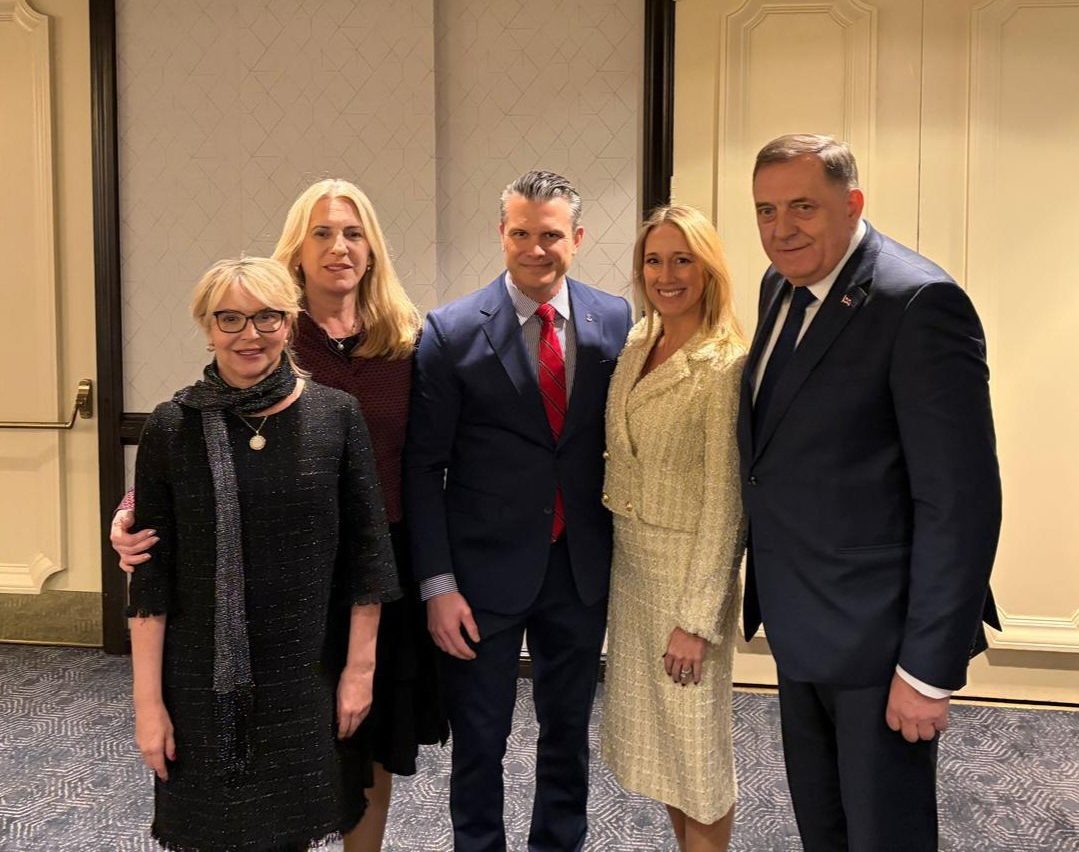
Lobbying, literally: RS leaders with Pete Hegseth in a lobby, a photo Mr. Dodik posted as a meeting (Photo: X / @MiloradDodik)
Sanin Mirvić
14.10.2026. 15:38
Mr. Bannon's anger has a Bosnian counterpart. A day later Jasmin Mujanović, a Bosnian-American political scientist, argued on this site that Milorad Dodik, the RS strongman, had broken one of the basic rules of politics by meddling in the domestic affairs of a country whose favor he seeks. The diagnosis is hard to dispute: Mr. Dodik overrated his own importance and underrated America's bipartisan commitment to the Balkans. Yet meddling of this kind takes two, one party seeking influence and another selling it. Mr. Dodik was the buyer; American consultants designed the product and charged handsomely for it.
While the Bosnian public argues over what exactly Mr. Dodik bought, Americans might ask what the deal cost them. The answer lies in filings made under the Foreign Agents Registration Act (FARA), which the Justice Department publishes.
Nine million dollars and a closed door
Between January 2025 and the spring of 2026, nine firms registered as foreign agents reported receiving more than $9 million from the RS government and its offices. The biggest contract, worth $4 million to Dickens & Madson, a Canadian firm, names independence for Republika Srpska from Bosnia and Herzegovina as its "ultimate goal." A firm run by Rod Blagojevich, a former governor of Illinois whom Mr. Trump pardoned, received $1,325,000 and passed $100,000 of it to a firm belonging to Michael Flynn, Mr. Trump's first national security adviser.

FARA exists so that the public knows who in Washington works for foreign governments, but it is enforced less and less. In February 2025 Pam Bondi, the attorney general, limited criminal prosecutions under the act to cases resembling traditional espionage. Filings still arrive, but punishment for those who fail to file has become unlikely. The names of Mr. LaCivita and Mr. Blair appear in none of the nine registrations made on behalf of Republika Srpska.
Who is paying?
The contracts are signed by RS ministries and representative offices, but the money does not come only from RS citizens. Indirect taxes are paid by everyone in Bosnia and Herzegovina and shared out under coefficients that have not changed since 2023, so RS still receives 34.44%. Officials from the Federation, the country's other, mainly Bosniak and Croat entity, claim that this hands RS tens of millions of marks a year more than it is due. Taxpayers in the Federation are thus, paradoxically, helping to pay for a lobbying campaign for secession.
The second source is in Belgrade. Telekom Srbija, which is majority-owned by the Serbian state and in turn owns most of m:tel, a Banja Luka operator, paid Continental Strategy, one of the firms on the RS payroll, $541,936 in the first half of 2026 (first and second quarter). That is more than twice what RS had paid the firm by the end of August. On Telekom's behalf Continental also lobbied the Export-Import Bank of the United States (EXIM), whose loans carry the full faith and credit of the American government and from which Telekom is seeking a loan for 5G equipment. RS's lobbyists asked for a meeting with the bank's chairman, too. The company says the lobbying concerned only its own business and denies paying for the visit of Mr. Trump's advisers. Where Telekom's interest ends and Banja Luka's begins, if the distinction matters at all, the filings do not show.
The third possible source is the least visible. In 2022 an unnamed American official claimed that Konstantin Malofeev, a Russian oligarch, had secretly helped finance Mr. Dodik's campaign in 2018. Without an investigation, any trail from that money to Washington lobbyists can be neither confirmed nor ruled out.
For Republicans: The swamp is still there
In 2016 Mr. Trump's movement promised to "drain the swamp" and to cut the ties between government, lobbyists, and foreign money. The RS filings show the opposite. Mr. Blair is the architect of the Republicans' redistricting strategy for this year's elections and, according to American media, was taking money from a foreign client at the same time. In March 2026 Mr. Flynn won a $1.25 million settlement from the federal government over what he calls malicious prosecution. Taxpayers paid his damages; a foreign government pays for his advice.
Not all Republicans in Congress are comfortable with this. In March 2026 Senators Chuck Grassley, Roger Wicker, and Thom Tillis and Representatives Mike Turner and Ann Wagner joined Democrats in asking Marco Rubio, the secretary of state, and Scott Bessent, the treasury secretary, to reimpose sanctions on Mr. Dodik, citing a law Congress had passed as part of the annual defense bill. At the end of September Mr. Dodik paid Vladimir Putin yet another visit.
For Democrats: Dayton on sale
In a September report, Democrats on the House Foreign Affairs Committee link the lifting of sanctions on Mr. Dodik on October 29, 2025, to the Southern Interconnection, a gas pipeline. The project was awarded without a tender to AAFS, a company founded four days after the American embassy said an American firm should build it. AAFS is run by Mr. Flynn's brother, Joseph, and by Jesse Binnall, a former lawyer for Mr. Trump. On the day the sanctions were lifted, Mr. Blagojevich's firm received $700,000 from RS.

At the report's crucial point, Bill Keating, the congressman behind it, writes "I believe," not "it is proven." The FARA filings show no payment to AAFS and no mention of the pipeline, so for now the link between the sanctions and the pipeline is visible only on the calendar. America brokered the Dayton agreement in 1995, and its military operations in Bosnia alone cost about $14 billion by 2004, according to the Congressional Research Service. A contract that names secession as its goal is paying to dismantle the very settlement in which Americans invested money, troops, and international standing.
It was O. Henry who, in 1904, coined the term "banana republic" for a fictional country modeled on Honduras, where power and concessions went to whoever paid. Republika Srpska applies the formula in both directions. At home it is run by a man who holds no office; it uses its budget to fund a goal the Constitutional Court has declared unconstitutional, and it declares its contracts secret. Toward Washington it offers concessions and buys access. America's allies bear the risk. The contract of another registered firm, Zell, lists the closure of EUFOR as a goal. That is the European Union's peacekeeping mission in Bosnia, in which soldiers from European countries, NATO members among them, serve.
The Southern Interconnection: Right goal, wrong route
The Southern Interconnection is a planned pipeline that would run from Zagvozd in Croatia through Posušje to Mostar and Novi Travnik, giving Bosnia and Herzegovina access, via the Croatian network, to the liquefied natural gas (LNG) terminal on the island of Krk. The two countries signed an intergovernmental agreement on it in Dubrovnik in April. There is a serious Republican case for the pipeline. Bosnia currently gets all its gas through a single pipe that runs via Serbia; it imports about 225 million cubic meters of Russian gas a year and pays Gazprom some $88 million for it. A second pipe would open a market for American LNG and reduce Russia's leverage. Mr. Wicker, a Republican, and Senator Jeanne Shaheen, a Democrat, could both support that goal.

The way it is being pursued, however, puts the goal at risk. In April the European Union warned that a special law written for a single investor could cost Bosnia access to the European energy market and some $1.16 billion from the EU's Growth Plan. A firm with no experience of pipelines, picked without a tender, is not the surest way to bring American gas to Bosnia, and the circle around it does not inspire confidence. Mr. Binnall is also the lawyer for Kimberly Guilfoyle, who resigned as ambassador to Greece at the White House's request on October 13. As ambassador, according to the Wall Street Journal, she pressed Balkan governments to do gas deals with Aktor, a Greek construction firm, and brought its lobbyist to meetings with foreign officials.
Who can drain the swamp?
Voters going to the polls on November 3 need not know where Banja Luka is to wonder why the people running their party's campaign work for a foreign government, and why the law on foreign agents is barely enforced any more. Republicans and Democrats frame these questions differently, but they are asking them about the same facts.
It would be naive to expect the draining to begin in Banja Luka, where the government serves as a front for Mr. Dodik, who does not even hold a formal post in it. Bosnia's Constitutional Court has built one dam: on September 24 it banned budget payments under the Dickens & Madson contract and the use of public money to lobby for unconstitutional aims. The ruling came late, since the full $4 million had been paid by October 2025, and it does not reach money that bypasses the RS budget.
The rest of the work lies in Washington. Mr. Mujanović notes that Democrats have promised to investigate Mr. Dodik's lobbying if they win Congress, and some Republicans are already pressing for sanctions to return. Congress has the tools: the Western Balkans sanctions law and oversight of how the Justice Department enforces FARA. Until it uses them, the public filings remain the fullest record of how much Republika Srpska paid, and to whom. They do not prove that a deal was made. But they show enough to give both parties reason to investigate.
O autoru

Sanin Mirvić
Politolog, specijalista za studije jugoistočne Evrope, istraživački analitičar i prevodilac.
Više od istog autora