In southern Cyprus, as every year, sirens sounded on July 20 while a military parade was held in the north. One commemorates the Turkish invasion of 1974, which followed a coup and resulted in the expulsion and displacement of hundreds of thousands of people; the other celebrates what Turkish officials call a “peace operation.” Fifty-two years later, the Republic of Cyprus remains the island’s only internationally recognized state, yet it exercises no authority in the north. There, a separate president, parliament, government, police force and courts form a political order recognized by Turkey alone.
Republika Srpska’s Cyprus Dream: A State It Cannot Have—and Should Not Want
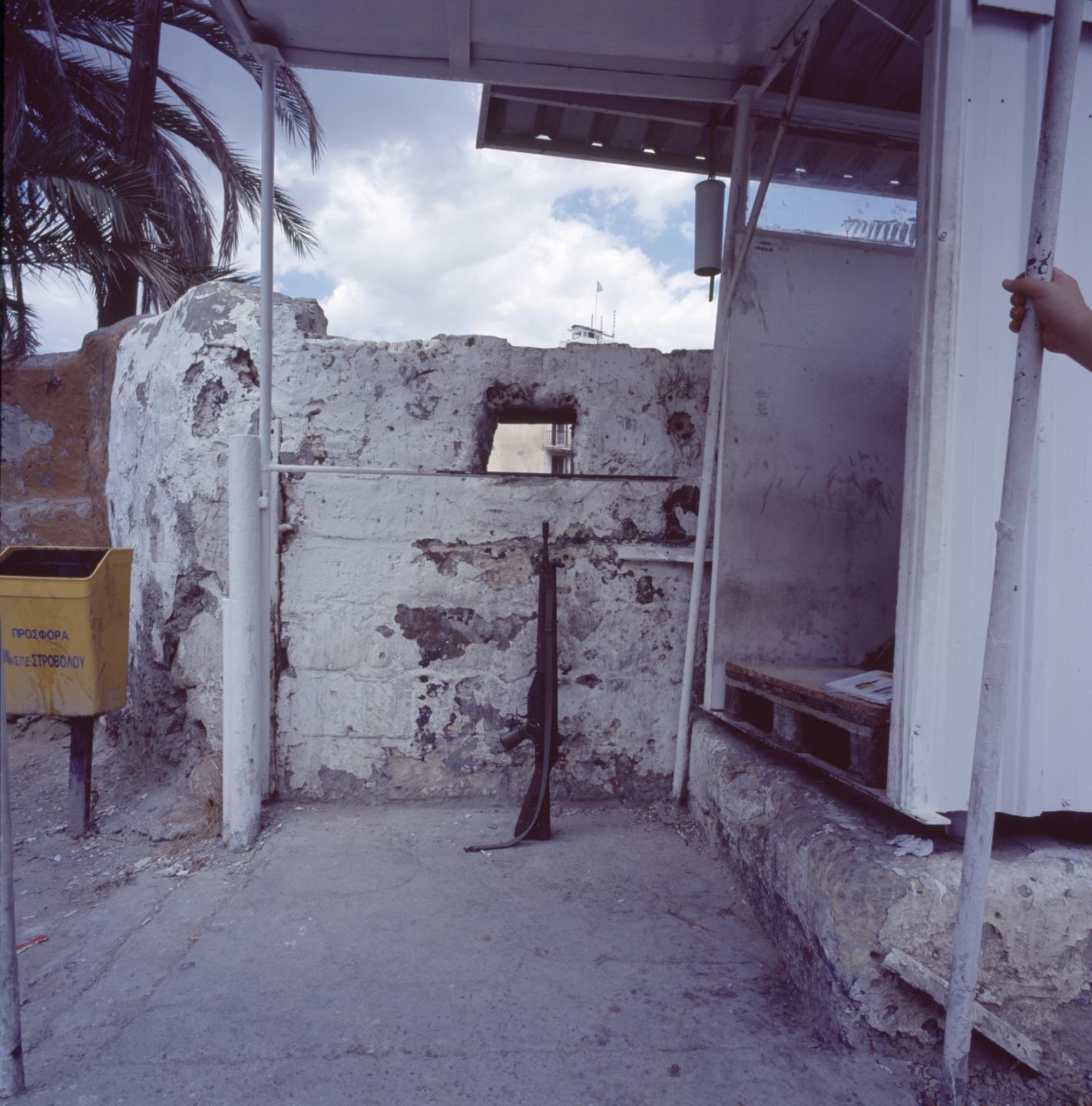
A Greek military position near the Green Line. (Photo: Sanin Mirvić/Corella)
Sanin Mirvić
03.08.2026. 10:28
The authorities of Republika Srpska (RS), Bosnia and Herzegovina’s Serb-majority entity, invoke that image ever more often—stripped of its bloody beginning and with reckless disregard for what it entails. Bosnia and Herzegovina would cease to exercise authority within the entity, the inter-entity boundary would become an international border and the world would eventually accept the new reality. Recognition could come later. The more immediate goal is to make separation permanent.
The intention has never been well hidden. During the crisis of 2025, the RS authorities tried to obstruct the state-level judiciary and security agencies, impose their own electoral and judicial rules, and prepare a new constitution for the entity. Six of those laws were later withdrawn, and in March 2026 the Constitutional Court of Bosnia and Herzegovina annulled the decision to draft the constitution. Yet the 69th report of the Office of the High Representative recorded that the entity government had signed a lobbying contract naming RS independence as the ultimate goal. The method remained the same: strip away one state power at a time until only an empty shell is left.

Antonis Klapsis, professor of diplomacy and international relations at the University of the Peloponnese, sees three possible futures for Cyprus: the status quo, a federation or an agreement establishing two recognized states. Banja Luka would prefer a blend of the first and third—slowly constructing a state without recognition while preserving independence as a promise for later. Cyprus, however, shows that no peaceful legal vacuum exists between those two outcomes.
Territory By Force, Not Law
Cyprus’s institutional division did not begin in 1974. Turkish Cypriot enclaves emerged after the violence of 1963–64, and a provisional Turkish Cypriot administration was proclaimed in 1967. Its institutions existed before the invasion, though they lacked a contiguous, militarily protected territory from which they could displace the authority of the Republic of Cyprus. War supplied it: the coup backed by the Greek junta and the Turkish landing displaced more than 200,000 people. The list of those missing from the conflict of 1963–74 contains the names of 2,002 Greek and Turkish Cypriots.
Unable to ground its claim to statehood in a separate act of foundation, Banja Luka is trying to reverse the sequence: to use institutions to produce what force produced in Cyprus, leaving territory and population to be dealt with later. RS is not ethnically homogeneous; it contains returnee communities and mixed towns. The Brčko District breaks its territorial continuity. For entity institutions to replace state institutions as their counterparts in northern Cyprus did after 1974, someone would have to decide who governs which territory and what happens to those who reject that authority. In Cyprus, force supplied the answer. The model does not avert war; it reproduces an order built on war’s consequences.
The Arithmetic the Argument Ignores
The analogy also fails the arithmetic test. Turkey has nearly 88 million inhabitants, whereas Greece and Cyprus together have about 11.5 million—a ratio of almost eight to one that allowed Ankara to turn disparity into lasting advantage. Serbia’s population is roughly twice that of Bosnia and Herzegovina.
The area of northern Cyprus amounts to less than half of one percent of Turkey’s territory, making it a marginal commitment for a country of that size. RS covers 24,641 square kilometers, almost one-third of the territory under Serbia’s effective control. What amounts to a marginal investment for Ankara would impose a vastly greater burden on Belgrade, one that could scarcely escape international scrutiny.
Borders Are Not Made by Decree
A peaceful dissolution of Bosnia and Herzegovina would require an agreement reached by the state as a whole and implemented through the constitutional process. Czechoslovakia could split peacefully because the Czech and Slovak political leaderships had agreed on the terms; Bosnia and Herzegovina has neither the necessary consent nor any prospect of securing it. The Constitution of Bosnia and Herzegovina affirms the state’s continuity within its internationally recognized borders, gives the entities no right to secede and prohibits even controls along the inter-entity boundary (IEBL).
Unilateral secession would therefore not end with a declaration. It would begin a struggle for effective control: taking over border crossings, public assets and security institutions, setting up a customs regime and dividing the public debt. Every step would reopen the same questions: Whose police, courts and laws prevail in Brčko, on Sarajevo’s outskirts, in the Drina Valley and in returnee settlements?
Mention Brčko and the fiction of a peaceful divorce falls apart. The District is under the sovereignty of Bosnia and Herzegovina, entity powers there are suspended and its territory—although a condominium of both entities—breaks the territorial continuity of the area under RS control. This is why the arbitral tribunal warned in 1999 that the dispute over Brčko risked renewed hostilities and even an attempt to destroy the state.
Without an agreement, any attempt to turn the inter-entity boundary into an international border would mean a return to force. Even war, expulsions and ethnic cleansing did not detach RS from Bosnia and Herzegovina. The belief that parliamentary votes and legislation can now achieve that same objective is no plan at all. It is a denial of history.
Even “Success” Would Bring Nothing Worth Having
Suppose nonetheless that RS overcame every obstacle and became a Balkan Northern Cyprus. What would it gain? It already has a constitution, president, parliament, government, police force and extensive powers. Through its representatives in state institutions, it can block policy across Bosnia and Herzegovina. Its residents carry internationally recognized passports, use the convertible mark and enjoy market access derived from the state’s international legal personality.
Northern Cyprus reveals where that calculation leads. It survives because Turkey has financed its security and infrastructure for decades, yet Ankara has failed to secure recognition for it from any other country. It uses the Turkish lira, remains outside the European Union’s customs territory and, in 2025, recorded trade of just €14.4 million across the Green Line—the UN-supervised buffer zone that has separated northern and southern Cyprus since 1974. A state in everyday life, a protectorate wherever sovereignty matters.
Such dependence would probably not deter advocates of secession; political, economic and security subordination to Belgrade is part of their project. That is precisely why the word “independence” conceals the opposite outcome. An unrecognized RS might retain its institutions while losing the rights and international connections that make them functional. The convertible mark might continue to circulate, though without guaranteed access to the Central Bank of Bosnia and Herzegovina, its reserves or its payments infrastructure. Entry into Serbia’s orbit would leave decisions on currency, security and foreign policy to Belgrade, just as northern Cyprus left them to Ankara.

Serbia, after all, bears little resemblance to Turkey. It has no troops in RS and lacks Turkey’s economic and diplomatic clout. As the successor to a signatory of the Dayton Peace Agreement, it is bound to respect Bosnia and Herzegovina’s territorial integrity—an obligation it had to reaffirm before the United Nations Security Council in May 2026. The present arrangement serves Belgrade better: RS politicians give it influence over decisions affecting the whole of Bosnia and Herzegovina, while the state those politicians undermine bears most of the entity’s costs. An independent RS would sacrifice that leverage and become a fiscal and security burden. Annexation by Serbia would fulfill the Banja Luka elite’s nationalist dream while reducing its president, parliament and government to provincial authorities subordinate to Belgrade.
Why the Cyprus Scenario Is an Illusion For Republika Srpska
The more plausible ambition of the RS authorities is indefinite parastatehood rather than independence: drawing on Bosnia and Herzegovina’s funds, market and international standing while steadily undermining its authority. That arrangement is more advantageous for the local elite than independence and more useful to Serbia than annexation.
Even this ambition derives its force from an analogy that does not fit its conditions. Unrecognized quasi-statehood survives in Cyprus because war created a contiguous, militarily protected territory and because a patron vastly more powerful than its client continues to sustain it. RS possesses neither condition. Its path runs through Brčko, returnee settlements and an unresolved border question, while depending on a patron for whom it would be a far greater burden than northern Cyprus has ever been for Turkey.
The need to spell this out is itself a measure of Bosnia and Herzegovina’s public debate. While Banja Luka looks to Northern Cyprus as a model, nearly 76 percent of Turkish Cypriots consider a return to a shared, federal state based on political equality acceptable. Desire points in the opposite direction: in Cyprus, people seek an escape from division through an order closer to Bosnia and Herzegovina’s; here, permanent division is sold as freedom.
This is not even a strategy, only the performance of one: an analogy repeated until it begins to sound plausible. In Cyprus, war created the division and time normalized it. Republika Srpska’s leaders want to remove war from the equation, ignore the arithmetic and still arrive at the same outcome—a mad calculation, surpassed only by the belief that any conceivable result could justify the price.
O autoru

Sanin Mirvić
Politolog, specijalista za studije jugoistočne Evrope, istraživački analitičar i prevodilac.
Više od istog autora