“A nationalist Prime Minister [Vučić was the President, not the Prime Minister, of Serbia – Ed.], an apologist for Milošević’s war crimes, has lost power”, concluded the editorial of the Greek left-wing publication, Rosa, upon the announcement of the Serbian election results. This is a far cry from the days of Mikis Theodorakis and his ilk organising a ‘charity concert’ in support of their beloved ‘anti-imperialist’, Slobodan Milošević, in 1999.
The Greek Left Has Learnt Little When it Comes to Bosnia
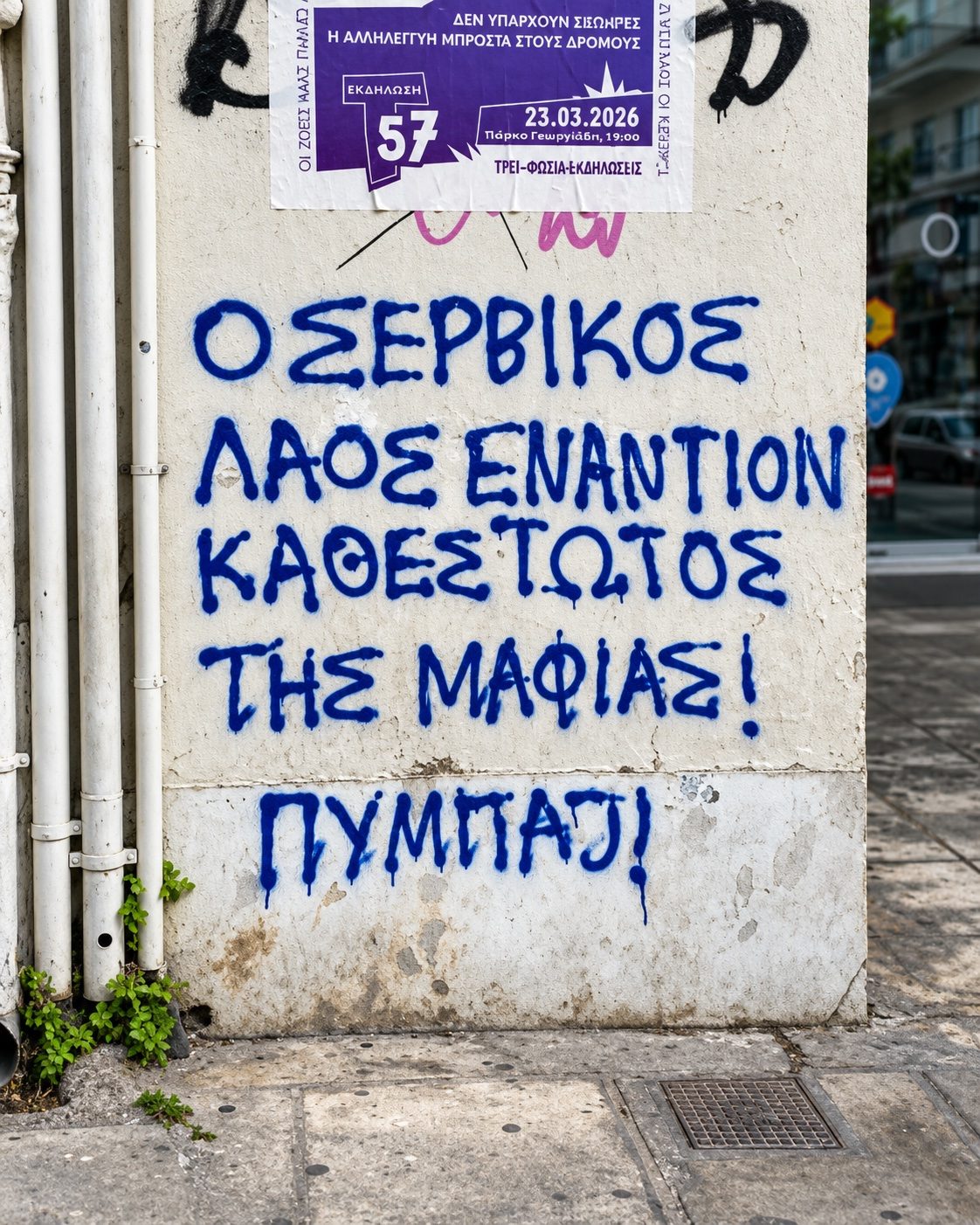
“The Serbian people against the mafia regime! Pumpaj!” — A message of solidarity with Serbia’s anti-government protests, written in Greek on a wall near Aristotelous Square, Thessaloniki. (Photo: Georgios Konstandi)
Georgios Konstandi
01.11.2026. 04:33
Today’s generation of left-wing politics in Greece looks and sounds differently to the pseudo anti-imperialism of the 1990’s. Back then, illusions of civilisational conflict saw hitherto reasonable people on Greece’s left support a mafia-style Serbian regime funding the mass slaughter of Bosnians and the first concentration camps on European soil since the Holocaust.
Today, Greek left-wing media is better at calling a spade a spade: Ratko Mladić was the butcher of Bosnia, and in Srebrenica, a genocide was committed in July 1995. However, behind these aesthetics of respectability, the Greek left’s exaltations of the Serbian Student List as a model for progressive politics indicate that, after thirty years, it has learnt very little when it comes to Bosnia and its civic struggle against Greater Serbian illogics.

The Greek left rushed to celebrate Sunday’s electoral victory of Serbia’s anti-Vučić Student List, which saw authoritarian and Srebrenica Genocide denier Aleksandar Vučić ousted from 14 years in power. The parallels between the 2024 Novi Sad train station collapse that sparked the student protests in Serbia and the 2023 Tempi train crash that killed 57 in Greece provide much of the emotional capital behind the Greek left’s support for the victorious Student List. So too does the pervasive sense of Greek-Serb solidarity that infuses a lot of the political discourse, both on the left and right of Greek politics.
The Mayor of Athens, Haris Doukas, of the social democrats PASOK, lauded the “turning of the page” of Serbian politics, while the left-wing newspaper I Avgi drew parallels between the Serbian Student List and the promise of change that saw Greece’s social democrats rise to power in 1981. These comments betray multiple failures by the Greek left. Firstly, to honestly confront its bloodied legacy in Bosnia. Secondly, to de-centre Serbia from its critical evaluation of politics in the ex-Yugoslav region. By failing on both counts, the Greek left risks using the aesthetics of camaraderie to flatten the structural and discursive violence within which Bosnians have been trying to build a functioning democracy.
Greek and Serbian left-wing mirrors in Bosnia
The Greek left remains unable, or perhaps unwilling, to face up to its complicity in the genocide against Bosnians between 1992 and 1995, a genocide the illogics of which have direct consequences for Bosnians to this day.
To draw a parallel between the Serbian Student List—an umbrella movement that includes some of the most overt supporters of the Greater Serbia imperial project—and the “slogan of change” that brought social democrat Andreas Papandreou to power in 1981 is indeed fitting, though not for the reasons the Greek left claims.
Andreas Papandreou returned to power as Prime Minister in October 1993, a year after the world had watched in horror the infamous Serb-run concentration camps in Bosnia: primarily Omarska, Trnopolje, Keraterm, and Manjača. UN Resolution 757 had already imposed a trade embargo against Milošević’s Yugoslavia in May 1992 for its failure to uphold a previous resolution that had called for an end to the Serb-led assault against Bosnia and Herzegovina.

This embargo was of little significance to Papandreou’s centre-left administration. A certain Vladimir Bokan, a Serbian arms and fuel smuggler living in Greece during the Yugoslav Wars, testified to Greek journalist Takis Michas that in 1994 he transported petroleum from a state-owned oil refinery in Greece to Montenegro, from which point it would be transported to Serbia. Like his conservative predecessor, Papandreou met with both Milošević and Bosnian Serb genocidaire Radovan Karadžić during the atrocities they were orchestrating in Bosnia. According to Greek mediator Aris Mousionis, the left-wing prime minister liked to call the anti-communist Karadžić “comrade” (Michas, 2002).
It is fitting, therefore, that the Greek left should frame the Serbian Student List as a continuation of Papandreou’s “slogan of change”. Like Greece’s left establishment, the Student List promises an end to the reign of corruption that has oppressed its own people. That is the “change” it equates with progress and, in so doing, expects its neighbours to circulate the same meaning and adopt the same joy Serbian citizens may feel as their own. Good civic Bosnians are expected to be happy in what makes Serbian citizens happy because that is what makes good on the promise of change. No need, therefore, to interrogate one’s positionality in relation to the change that is promised.
By positioning themselves and the Serbian Student List as regional torchbearers of progress, the Greek left engages in a violent gaslighting of Bosnia’s victims of Milosevic’s terror and the daily terror of living under the illogics of genocide. It whitewashes its own complicity in the atrocities under the false banner of solidarity without confronting the structural violence that Bosnians have inherited from the Greater Serbia project that was supported by Greek social democrats.
Bosnian leftists and civic actors face an uphill struggle to forge a liberal democracy and strengthen its democratic institutions against the very ethnonationalist principles that are built into its postwar political infrastructure. These structural challenges did not emerge in a vacuum: they were bequeathed to the people of Bosnia as a suitable ‘compromise’ between a multiethnic, civic Bosnia and the Greater Serbian (and Croatian colonialist) vision for an ethnically segregated Bosnia.

Instead of recognising this anti-imperialist struggle, the Greek left continues to alienate Bosnian leftists in its perpetuation of a Serb-centric view of progressive politics. It is to this we now turn.
Decolonising the Balkan left
When the Mayor of Athens hailed the Student List’s victory as a “turning of the political page”, he revealed the Greek left’s general blindness to how Serbia’s neighbours may experience the new administration, in particular Bosnians.
On the eve of Sunday’s election, Student List representative Nemanja Karović spoke on Serbian state TV about the List’s policy vis-à-vis Bosnia and Herzegovina. On the issue of the Srebrenica Genocide, he refused to recognise the International Criminal Tribunal for the former Yugoslavia’s (ICTY) ruling that the massacre of 8,372 Bosniaks by the Republika Srpska Army in July 1995 constituted genocide. Perhaps more tellingly, he went on to stress that Bosnia’s Republika Srpska entity, which obtained its Serb demographic majority through the genocidal atrocities of 1992-1995, cannot be considered a “genocidal entity”.
Meanwhile, we have seen footage after footage of Serbian Student List supporters waving ‘Kosovo is Serbia’ symbols, lauding convicted genocidaire Ratko Mladić as a “hero” and marching alongside Serbian veterans of the Yugoslav People’s Army, which in 1992-1995 assisted Serb forces in their onslaught against Bosnian civilians and the resettling of Bosniak and Croat property with Serbs.
If the Greek left is serious about its anti-colonial credentials, it would be wise to start with its position vis-à-vis Bosnia. Instead of unconditionally supporting the Student List, it should be holding it to account on its commitment to decolonising its relations with Bosnia and Bosnians. At the core of that commitment must be a redrawing of relations with the genocidal entity that is the Republika Srpska. Namely, by putting diplomatic pressure on the RS leadership to back down from its partitionist coups, to cease its constant attacks against Bosniak returnees via the police, and committing to a complete volte-face from Belgrade regarding its economic and political interference in northern and eastern Bosnia. Indeed, there is little point in supporting Palestinian anti-colonial resistance (as both the Greek left and Serbia’s Student List claim to do) if they are not willing to give up neocolonialist illogics in their backyard.
Bosnian civic actors, both at the upper levels and grassroots of society, deserve nothing less than reliable partners. If the Greek left is serious about making a break with its love affair with ethnonationalist violence, it would do well to reach out to Bosnia’s left. Its media should be platforming their takes on political events. Its politicians should be supporting their calls to decolonise regional foreign policy. If not, the Greek left will continue to perpetuate Serb-centric illogics wrapped in the aesthetics of brotherhood and solidarity.
O autoru

Georgios Konstandi
Georgios Konstandi je doktorant na Univerzitetu u Cambridgeu i potpredsjednik Udruženja za bošnjačke studije (Bosniak Studies Association). U istraživanju genocida u Bosni bavi se antropologijom emocija, religijom i proizvodnjom istine u poslijeratnom životu Bošnjaka. Osnivač je edukativnog projekta o genocidu „Glasovi sa Drine“ (Voices from the Drina), koji putem društvenih mreža oživljava događaje genocida u dolini Drine. Radio je kao pomoćnik urednika u Centru za postkonfliktna istraživanja u Sarajevu, a stažirao je u Memorijalnom centru Srebrenica. Prije toga bio je urednik u Post-Soviet Press Groupu, koju vodi dr. Ben Noble, saradnik Chatham Housea. Njegovi tekstovi o poslijeratnim prilikama u Bosni objavljivani su na Balkan Insight, u Međunarodnom institutu za mir, na Just Securityju i Istrazi.
Više od istog autora