At the end of December 2020, the German ambassador at the time, Margaret Uebber, informed Presidency members Šefik Džaferović and Željko Komšić that the German government would seek the appointment of Christian Schmidt as the new high representative in Bosnia and Herzegovina. Even before that, Turkish President Recep Tayyip Erdogan had told the Party of Democratic Action (SDA) and Komšić that Angela Merkel had asked Turkey to support Schmidt.
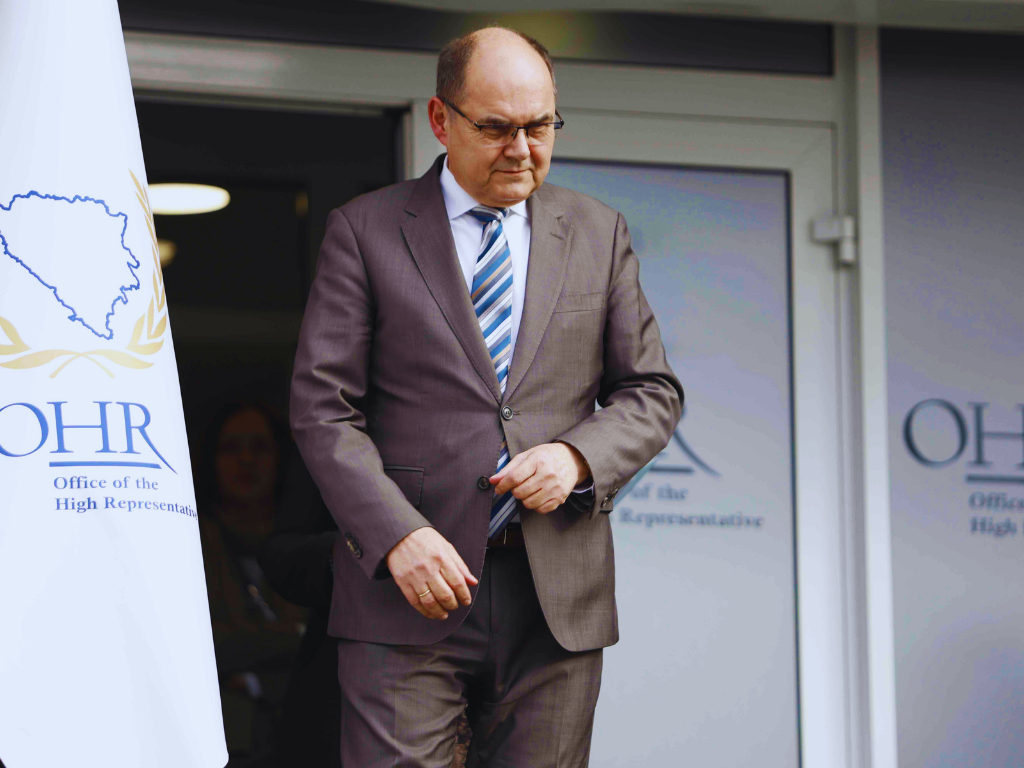
The Biden Administration’s Man in Bosnia: The Rise and Fall of Christian Schmidt
Haris Imamović
12.05.2026. 11:07
This came one month after Joe Biden’s victory. The United States was then in the midst of a severe crisis after Donald Trump refused to concede the election. Everything culminated on January 6th 2021, when violent demonstrators stormed the U.S. Congress. Unlike Merkel, no one in Washington had Bosnia on their mind.
By the time the Biden administration took office, Schmidt had already been locked in as Germany’s official candidate. The Americans, eager to rebuild relations with the EU after Trump's first term, found it difficult to reject him. Washington eventually accepted his appointment, reluctantly, at the Peace Implementation Council (PIC) Steering Board meeting on May 27th 2021. But because of the way he had been chosen, the Americans did not stand behind Schmidt in that earliest phase. He was not seen as their man.
Informed that the incoming Biden administration would want to revive the use of the Bonn powers in Bosnia, Merkel, a firm opponent of those powers, acted pre-emptively. By installing a high representative loyal to her, she placed the Office of the High Representative (OHR) under her control. Schmidt was regarded not merely as Germany’s candidate, but as Merkel’s personal choice.
Then everything changed. In September 2021, the CDU lost the election in Germany, and Merkel stepped down as chancellor. The new government in Berlin, led by Olaf Scholz’s SPD, either did not want to integrate the former CDU/CSU minister or was unable to do so. The Americans then “took over” Schmidt, and he remained under their strict political control until the end of Biden’s term.
Although he was conceived as a symbol of greater German presence, Schmidt ultimately became a symbol of total U.S. dominance inside the PIC. Behind all his major decisions stood the Biden administration, not Berlin or Zagreb.
Reaffirming the Federation
At the very moment when the Americans took control of Schmidt, in September 2021, Bosnia and Herzegovina was in the middle of a major political crisis. The first trigger was the ban on genocide denial, imposed by former high representative Valentin Inzko on July 22nd, 2021, shortly before his departure and without support from the PIC. What began as resistance in Republika Srpska (RS) to Inzko’s decision turned into an attack by the RS authorities on state institutions. In October 2021, the National Assembly of the RS adopted the Law on Medicines and Medical Devices of the RS, attempting unilaterally to take over the powers of Bosnia and Herzegovina’s state-level Agency for Medicines. BiH was approaching the edge of conflict.
The Biden administration, already working on the assumption that Russia was moving toward an invasion of Ukraine, made a strategic decision to shore up the Dayton peace in BiH by repairing Bosniak-Croat relations. That crisis had culminated in the inability to form a government in the Federation of BiH after the 2014 elections. For that purpose — the reaffirmation of the Bosniak-Croat Federation — Matthew Palmer was appointed at the end of September 2021 as the special U.S. envoy for electoral reform.
The logic of reaffirming the Federation was best explained by Derek Chollet, adviser to Secretary of State Antony Blinken, who wrote in his study of Dayton that “if there is any chance for peace, the Muslims and Croats must cooperate politically, economically, and most importantly militarily” against the Serb side.

The Biden administration, staffed by many veterans of the Clinton era, was guided by the pattern of the summer and autumn of 1995.
In the autumn of 2021, Biden’s team started from the premise that Republika Srpska had no chance of imposing its will if the Federation, which accounts for roughly two-thirds of BiH’s demographic and economic weight, was at least somewhat united, stable, and committed to preserving Dayton. RS would not dare enter a conflict as long as there was peace inside the Federation. The only chance for the Serb side to threaten BiH was for the Federation first to disintegrate through a renewed Bosniak-Croat conflict.
Biden’s people saw conflict inside the Federation as fuel for Dodik’s secessionism. That is why, in order to strengthen the Federation, they organized negotiations in Neum. Yet despite numerous attempts, the Bosniak and Croat parties failed to reach a consensus. It is no secret that Palmer expected the Bosniak side to make more concessions than the Croat side.
Encouraged by the failure of the Bosniak-Croat negotiations in Neum, the National Assembly of the RS adopted the Law on Immovable Property on February 10th 2022, raising the crisis to a higher level.
About ten days later, the war in Ukraine began. The situation was close to escalation. EUFOR increased its troop numbers for the first time in its history.
After the collapse of the Neum process, Palmer made several more attempts in Sarajevo. Then, at the end of March 2022, he left his post as special envoy for electoral reform. Unwilling to leave matters to chance, the Americans decided to use the ultimate instrument: the Bonn powers. Their reasoning was simple. If Palmer’s diplomacy could neither reaffirm the Federation nor restrain RS, then the cudgel of the Bonn powers would. Christian Schmidt stepped onto the historical stage.
On April 12th 2022, Schmidt first suspended the RS Law on Immovable Property and amended the Law on the Temporary Prohibition of Disposal of State Property. This was a sign of a major shift. A clear message from Washington to Banja Luka. For the first time since 2011, a high representative, backed by the PIC, used the Bonn powers. And this was only the beginning.
In the summer of 2022, the OHR secured funds for holding the elections and made its first cut into the Election Law by imposing an initial package of technical amendments. Protests followed, but they were too quiet and too small. Then, on election night, October 2nd, 2022, Schmidt imposed amendments to the Constitution of the Federation and the Election Law. This was the high point of his mandate.
There should be no confusion: this was not Christian Schmidt’s independent decision. It was the Biden administration’s decision to use the Bonn powers to do what Palmer’s mediation and consensus among local actors had failed to achieve: reaffirm the Bosniak-Croat Federation.
More precisely, the decision was designed to guarantee representation for Croats in federal and state-level authorities, where that representation had previously been contested. The aim was to bind Croats, at least minimally, to the Federation, so that in the event of a total crisis, they would not follow Serb politics all the way.
At the same time, the Biden administration decided not to change the method for electing the BiH Presidency member, although Palmer had said in the autumn of 2021 that this was one of the goals of his mission. The decision not to touch the Presidency was a concession to the Bosniaks: an acknowledgment of the legitimacy of their ambition to exert greater influence over the composition of state bodies than the parity formula allows.
The fact that the Election Law was not amended with regard to the Presidency is also the strongest proof that Schmidt was not acting personally. Had he been, as some claimed, “under Zagreb’s control,” he would have had to change the method for electing Presidency members in October 2022, or at least later. He did not. The Americans had given no such order.

The next major crisis, from the summer of 2023 to the spring of 2025, showed that the American strategy of reaffirming the Federation had, to a certain extent, produced the desired result. The Croats did not support the removal of SNSD officials from the Council of Ministers. Yet they also did not support RS decisions on the unilateral takeover of state-level competences — the judiciary, SIPA, and so on — nor did they join the same project. Unlike in the summer of 2022, when the Croat National Assembly (HNS) adopted conclusions threatening the territorial reorganization of BiH, HNS president Dragan Čović now dismisses talk of a third entity as nonsense.
The Unfinished Conflict with Dodik
After the intervention on election night in 2022, Schmidt held back until April 27th, 2023, when he issued a decision suspending the Constitution of the Federation for 24 hours, allowing the Trojka and HDZ to form a government without the consent of the Bosniak vice-president. Schmidt did this on instructions from the Biden administration, specifically from the U.S. ambassador in Sarajevo at the time, Michael Murphy.
The American goal was to punish the SDA, which the Biden administration blamed for the failure of the Neum negotiations. The Trojka, meanwhile, had shown a willingness to be extremely cooperative with HDZ. That was music to the ears of Biden’s people, who were then determined to reaffirm the Federation as much as possible and thereby weaken Dodik’s position.
If the Biden administration ever had an original intention to confront Dodik, it is worth recalling that nothing of the sort happened from Biden’s arrival in the White House in early 2021 until the summer of 2023. Intensive sanctions against the RS authorities began only in October 2023.
For two and a half years of its mandate, then, the Biden administration did not touch Dodik. More than that, it treated him as a partner. Ambassador Murphy, for example, issued a statement on January 25th, 2023, welcoming the formation of the new BiH Council of Ministers, including Dodik’s cadre.
Only two and a half years after Biden entered the White House, at the end of June 2023, did the National Assembly of the RS adopt laws on the non-implementation of decisions by the OHR and the Constitutional Court on the territory of that entity.
Prompted by the Americans, the OHR reacted on July 1st by annulling the decisions of the RS National Assembly and imposing amendments to the BiH Criminal Code. Those amendments made non-compliance with decisions of the OHR and the BiH Constitutional Court a criminal offense. This opened the way for the prosecution of Milorad Dodik.
For the remaining year and a half of its term, with the situation in the Federation relatively stable between the Troika and HDZ, the Biden administration had one task: to bring the case against Dodik to its conclusion. It failed. That is its greatest sin. A catastrophic failure.
Some will say the Biden administration entered the conflict with Dodik too late. Others will say it never truly initiated it. Either way, by prompting the OHR to amend the Criminal Code, the Biden administration opened a case against Dodik. But unlike, for example, the case against Novalić, it did not finish the job. It left it to the Trump administration.
In the end, the Trump administration struck a deal with Dodik: the conviction would be formally respected, while in return, sanctions against Dodik would be lifted and Christian Schmidt, as a symbol of the Biden era, would be left without a job. Although Michael Murphy now complains on X about Trump’s people, the truth is that the root of much that has gone wrong over the past six months lies in Murphy’s own irresponsibility and ineffectiveness.
Partial success in the Federation and defeat in the conflict with Dodik: a miserable balance sheet for the Biden administration.
From Milići came the fleet, to knock Christian Schmidt off his seat…
Dodik said back in October 2025 that the deal he had with the Americans meant the end of Schmidt, but also the end of the Bonn powers. The bell has already tolled for Schmidt. The only question left is what will happen to the Bonn powers. Is Dodik right on that point as well?
Schmidt’s time in fact ran out the day the Democrats lost the presidential election in America. Although originally conceived as an emissary of Angela Merkel, for most of his mandate, he was an extension of the Biden administration. When the U.S. representative told a UN Security Council session that the Trump administration would not support intensive interventionism in BiH, it became clear that Schmidt’s era had passed. Even if he formally stayed in office, he would be like Inzko: a Stone Sleeper figure, present but politically inert.

As a rule, no high representative has made decisions without prior support from the United States and the most important European powers — Germany, France, and Britain. This means that even the OHR’s agility under Paddy Ashdown was not the result of Ashdown’s personality so much as the determination of the great powers to implement Dayton. Personality mattered, but it was not decisive. Ashdown was above all a symbol, the expression of a certain balance inside the PIC, not the generator of that balance. The same applies to other high representatives, from Carl Bildt to Christian Schmidt.
After the Trump administration’s victory, even if Schmidt had stayed on for several more years, or if someone energetic and decisive like Ashdown had been appointed, he could not have pursued a policy different from the one Inzko led between 2011 and 2021. His hands would have been tied.
A Signal That the OHR Is Nearing Its End
The fact that the high representative is above all a symbol is also shown by the name of Antonio Zanardi Landi, the Italian diplomat reportedly set to succeed Schmidt.
First, Zanardi is 76 years old. If appointed, that alone sends a message that he will not remain for long. Schmidt, by comparison, is seven years younger — a full mandate, and more.
Second, unlike Schmidt, who came to BiH from the German federal government, Zanardi would arrive from the politically weightless post of the Order of Malta's ambassador to the Holy See. The message is clear: he does not carry the political weight of his predecessor.
Third, Zanardi served as Italy’s ambassador to Belgrade and later to Moscow. That is meant to suggest that he “knows how to talk to the Serbs as well.” Unlike Germany, Italy has not imposed sanctions on Dodik. Moreover, in recent years, Italian diplomats have been known at PIC meetings to defend the RS authorities. Zanardi would therefore be a symbol of a cooperative, rather than confrontational, relationship between the international community and RS.
In these circumstances, the best that can be done is to preserve the OHR formally and legally, so that in some new political constellation it might once again be revived and used for the purpose for which it was established: reducing the scope for obstruction of the Dayton Agreement.
O autoru

Haris Imamović
Član redakcije portala !Odgovor. Ranije pisao za „Istragu“, „E-novine“, “Analiziraj.ba”, „Dane“. U mandatu 2018–2022. bio savjetnik člana Predsjedništva iz reda bošnjačkoga naroda i tokom tog perioda sudjelovao u radu Organizacionog odbora za obilježavanje genocida u Srebrenici. Objavio roman „Vedran i vatrogasci“ (2022).
Više od istog autora