For years, the Balkans occupied a peculiar place in Washington’s strategic thinking: never fully resolved, never entirely forgotten, but increasingly treated as stable enough to function on geopolitical autopilot.
Robin Brooks: How the Balkans Lost Part of Their Trust in Washington
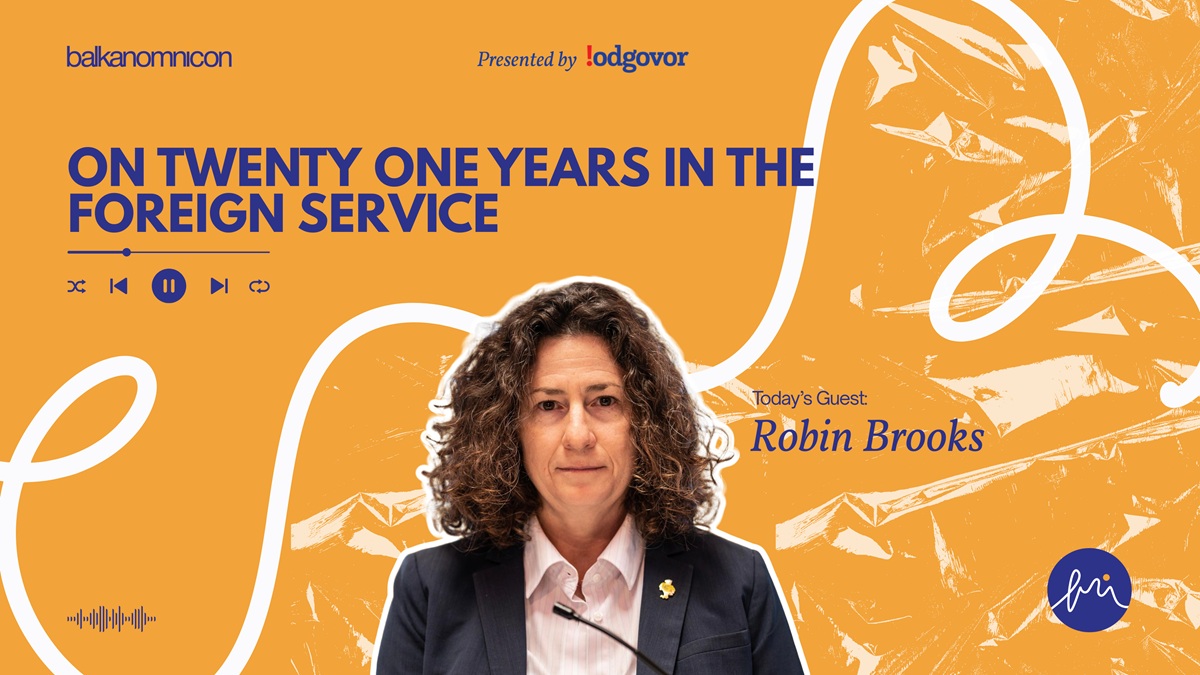
UNDERSTANDING THE BALKANS ONE EPISODE AT A TIME - 1
!Odgovor
12.05.2026. 09:26
That is how Robin Brooks, former US diplomat and former Director for Balkans and Central Europe at the National Security Council, describes the evolution of American policy toward the region.
“During the Obama administration, the Balkans were almost on autopilot,” said Brooks while speaking to Jasmin Mujanović on the Balkanomnicon podcast.
The framework appeared durable enough: NATO expansion, the Dayton architecture, KFOR, EU integration and coordination with European allies.
“There was almost not even an interagency policy committee meeting about anything having to do with the Western Balkans,” she recalls. “Partly because we didn’t need to. It was on autopilot.”
But Brooks now believes Washington underestimated the long-term risks of that approach.
“We may have taken our eye off the ball a little bit in Eastern Europe and to our detriment,” she says.
That assessment carries particular weight in Bosnia and Herzegovina, which remained formally stable while unresolved political tensions continued accumulating beneath the surface.
Even when Washington’s attention shifted elsewhere, Brooks says the United States remained committed to “Bosnia and Herzegovina as a single sovereign state” and continued supporting Dayton. Yet, in her telling, the real shift came during Donald Trump’s first administration — not necessarily in formal policy, but in political signaling.
“It sent a message to people of a differing level of care about that region’s security from the United States and a differing level of care about that region’s democratic institutions,” she says.
For Bosnia, where political stability has always depended heavily on perceptions of Western resolve, that distinction mattered enormously.
At one point, Brooks openly acknowledges that Washington could have devoted greater attention to Bosnia’s institutional fragility, including “figuring out how to support the High Representative” and understanding “the spoiler role that Hungary could play in the region.”
Most notably, she references efforts aimed at “preventing Dodik from taking Republika Srpska to secession.”
One of the most revealing parts of Brooks’ account is her description of how American foreign policy actually functions behind closed doors.
“States are not black boxes,” she says, emphasizing the enormous role played by personalities, ambassadors, advisers, signaling and informal relationships.
That dynamic, she argues, is often poorly understood in the Balkans, where American policy is frequently imagined as a perfectly centralized machine.
In reality, Brooks describes something far more fluid.
“The ambassador receives an instruction from Washington and carries it out,” she explains. “But if the ambassador is a political appointee friend of the president, it’s even more influential.”
For Bosnia and Herzegovina, where American ambassadors have historically exercised unusually visible influence, Brooks’ explanation offers a rare glimpse into how that system actually works: less through conspiracy than through access, trust and the ability to shape Washington’s perception of events on the ground.
The Balkans may no longer dominate American foreign policy as they did during the wars of the 1990s.
But, as Brooks’ reflections make clear, they have never fully disappeared from Washington’s strategic horizon either.
O autoru

!Odgovor
Svjesni da je živi dijalog istinski ravnopravnih sagovornika temelj razumijevanja i postizanja općeg dobra, platformu nudimo svim zainteresiranim autorima, organizacijama i grupama koje dijele naše osnovne ciljeve.
Više od istog autora