Recently, in my article Wilders and Orbán in Sarajevo, 1983, I touched upon a Yugonostalgic portrait of contemporary Sarajevo presented by Midhat Ajanović. There, I pointed out an unusual connection between Islamophobic Yugonostalgia and the Western anti-immigrant right. Not even three full weeks went by before reality proved me right.
A Fellow at the Margaret Thatcher Center Challenging Margaret Thatcher’s Legacy
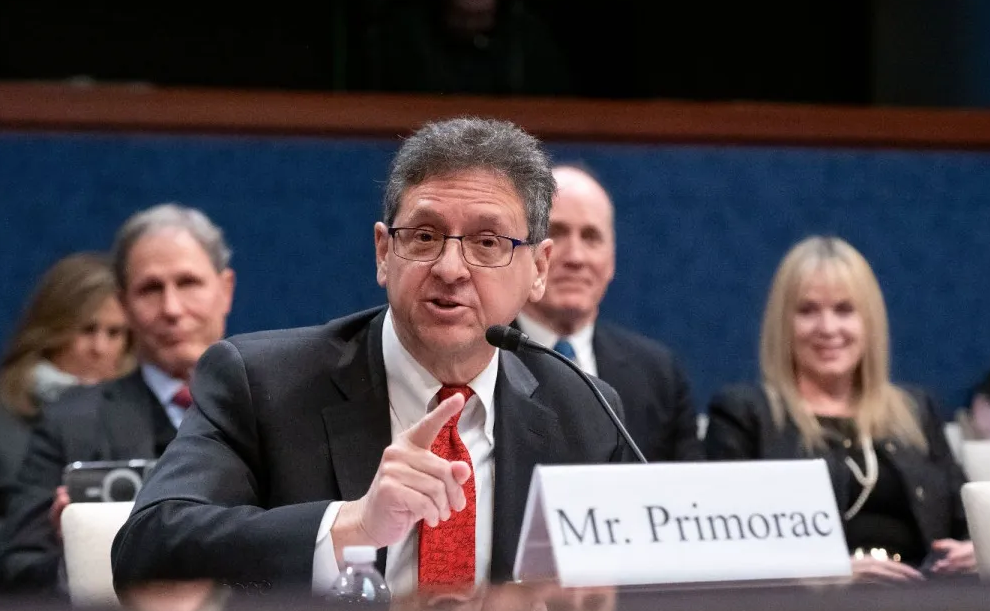
Primorac (Foto: X)
Haris Imamović
20.02.2026. 07:13
A 'Christian' Who Doesn’t Know the Difference Between an Archbishop and a Cardinal
Max Primorac, a researcher at the Margaret Thatcher Center for Freedom at the Heritage Foundation, published a defamatory piece in the marginal American newspaper The Washington Times titled “An Islamist State on NATO’s Border?”, targeting Bosnia and Herzegovina.
In this short rant—headlined “Sarajevo is Becoming Increasingly Extremist”—we can observe, among other things, the following point:
“Bosnia’s joint capital, Sarajevo, is not the celebrated model of cosmopolitan multireligious coexistence the world saw during the 1984 Olympics. Women now cover their hair. Full-bodied niqabs reminiscent of Afghanistan are not uncommon. Gulf-financed mosques dot the city skyline. Former Sarajevo Cardinal Vinko Puljic lamented that “Sarajevo has become a solely Muslim city.”
The clearest sign of what kind of Christian—indeed, what kind of Catholic—Primorac is, and how poorly he understands Bosnia and Herzegovina, is straightforward: he doesn’t even realize that Monsignor Puljić is still a cardinal and that he only stepped down as Archbishop of Vrhbosna, passing the office to Tomo Vukšić.
Furthermore, it is very revealing that this supposed Christian zealot from the Heritage Foundation uses the same contrast between the former “multireligious” Sarajevo and today’s “Muslim” Sarajevo—an attitude often seen among authors with a communist background.
Primorac Against Margaret Thatcher
The irony deepens: Primorac is a researcher at a “Center for Freedom” named after former British Prime Minister Margaret Thatcher.
Mrs. Thatcher was one of the most influential voices in Western public life, supporting the Bosnian cause from 1992 to 1995. While Primorac accuses Alija Izetbegović, the first President of the Bosnian Republic, of being an Islamic extremist, Thatcher wrote that “the government of Alija Izetbegović in Sarajevo is the legal and internationally recognized government of the Bosnian Republic,” and urged the West to support it. While Primorac’s face tightens at any mention of our military potential, Thatcher compared the efforts of the Army of the Republic of Bosnia and Herzegovina (ARBiH) to those of the British military in the Battle of Britain.
For her, there was no doubt about what was happening in Bosnia. What was underway, she wrote in December 1992, was “Their agony is above all the result of Serbia's ruthless aggression. But we in the West are to blame as well. We could have stopped this, we could still do so.”
“We have repeatedly stated in public,” Thatcher said, “that we will not intervene militarily, so removing even a nagging uncertainty from the minds of the generals in Belgrade. (…) We have continued to impose an arms embargo on Bosnia (and Croatia), knowing that this leaves overwhelming military superiority in the hands of the Serbs, who have inherited from the old Yugoslavia the weapons of the third largest army in Europe.”
Thatcher warned that such a Western stance would favor Islamist extremists and create space for Iranian influence in Bosnia and Herzegovina. To prevent this, she urged Western governments to support Sarajevo and oppose Serbian aggression.
In other words, a recommendation completely opposite to Primorac’s.
“The Serbs,” Thatcher said, “should be given 48 hours to withdraw from the surrounds of Sarajevo and other Bosnian towns and allow through convoys of aid. (…) There must also be an immediate end to the arms embargo against Bosnia and Croatia. And if hostilities continue we should supply arms to enable them to defend themselves.
Thatcher went further: “Serbia must be given another ultimatum: the complete withdrawal of Serbian forces from Bosnia.”
“These requirements,” she wrote, “must be backed by force. There is no need for a heavy commitment of land troops. The West has the technology and the airpower to make this unnecessary. If Serb forces do not comply with these ultimata, air strikes must be launched against Serb artillery positions, tanks, ammunition dumps and supply lines, including military bases within Serbia. (Heavy artillery and tanks are more vulnerable in winter, because they are more difficult to conceal or move. In any case, the Bosnians can pin-point them for us.).”
Finally, Thatcher proposed “the right international framework for returning peace and stability to the region.” “A UN-sanctioned protectorate or ‘mandate,’ she said, ‘should be established by which perhaps two acceptable outside powers would uphold the security of a demilitarised Bosnia.”
The conclusion of the Dayton Agreement and its implementation prove that Thatcher was right: although Bosnia and Herzegovina is not a protectorate, the Office of the High Representative (OHR) and the Peace Implementation Council (PIC), along with defense reform, have played a crucial role in maintaining peace. The international presence in Bosnia and Herzegovina is limited but remains essential to Europe’s overall security framework.
In general, everything Max Primorac writes in his articles opposes the concept that Margaret Thatcher herself supported. On one hand, he argues for abolishing the OHR supposedly in the name of Bosnia and Herzegovina’s sovereignty; on the other, he suggests destroying that sovereignty by imposing a Third entity from outside.

The True Heirs of Lady Thatcher’s Legacy
Unlike Primorac, the Margaret Thatcher Center for Freedom and the Heritage Foundation also include faithful followers of Lady Thatcher—such as former British Prime Minister Liz Truss and Nile Gardiner, a former adviser to the Iron Lady and currently the director of the “Margaret Thatcher Center for Freedom,” where Primorac currently works.
Truth must be told: Truss did not stand out as a prime minister. Honesty requires us to admit she faced a difficult period; her party was already in opposition. Still, she remains an influential figure—especially within the Heritage Foundation’s circles.
That’s why it’s important to remember that Truss, as the UK’s foreign secretary, visited Sarajevo in May 2022 and met with Presidency members Šefik Džaferović, Željko Komšić, and Milorad Dodik. As an adviser to the first-listed, I attended the meeting where Truss delivered very direct messages to Dodik. I recall, for example, that he asked for a moment, but at that moment she stood up and ended the meeting, cutting him off.
During a public speech at the Armed Forces Hall, Truss said, in the context of the invasion of Ukraine: “We must learn the lessons of history and the consequences of inaction. The West took too long to act in the 1990s. We were not bold enough to prevent terrible events such as the genocide at Srebrenica. This hesitancy only prolonged the fighting. Sarajevo suffered under siege for 1,425 days. We should have acted sooner.”
Her visit took place shortly after the UK government imposed sanctions on ex Republika Srpska President Milorad Dodik and his closest ally Željka Cvijanović. For example, Nile Gardiner, the director of the “Margaret Thatcher Center for Freedom,” praised the sanctions on officials of Republika Srpska.
Regarding those sanctions, Truss said in Sarajevo: “We are working to protect the hard-won Dayton Peace Agreement. That’s why we have sanctioned 2 politicians for their unacceptable nationalist rhetoric and denial of the genocide. We will support Bosnia and Herzegovina’s territorial integrity and sovereignty, and we will back High Rep Christian Schmidt.”
Being a Heritage Foundation star didn't prevent Truss from making those statements.
Here lies a fundamental flaw in our public sphere—among our politicians and their overly liberal advisers: they cannot even imagine that radical right-wingers, like Truss or Gardiner, who oppose USAID, gender ideology, Marxism, and so on, might actually be on our side.
That intellectual laziness causes double harm. It traps us in a narrow, provincial view where we see the world through a simple lens: “ours” are leftists and liberals like Hillary Clinton and Joe Biden. At the same time, “theirs” are all radical right-wingers—even the “Margaret Thatcher” Center.
The problem isn't that none of our officials reached out to Truss or Gardiner to create, within right-wing circles in the West, a counter-narrative to Primorac. The real issue is that, because of this intellectual flaw, it never even occurred to them that we might find common ground with people at the Heritage Foundation.
O autoru
Haris Imamović
Član redakcije portala !Odgovor. Ranije pisao za „Istragu“, „E-novine“, “Analiziraj.ba”, „Dane“. U mandatu 2018–2022. bio savjetnik člana Predsjedništva iz reda bošnjačkoga naroda i tokom tog perioda sudjelovao u radu Organizacionog odbora za obilježavanje genocida u Srebrenici. Objavio roman „Vedran i vatrogasci“ (2022).
Više od istog autora