When Bosnian voters head to the polls later this year, they will do so in the shadow of a generational crisis within the transatlantic community. They will, of course, be unable to sway the views of the major powers through their democratic exercise. But they must nevertheless position themselves with respect to these circumstances all the same. Especially because amid the present fraying of the “Euro-Atlantic” concept, the U.S. has made significant economic overtures to Bosnia and Herzegovina, which may weigh heavily upon the country’s future geopolitical circumstances.
What Washington Wants, and What Sarajevo Needs
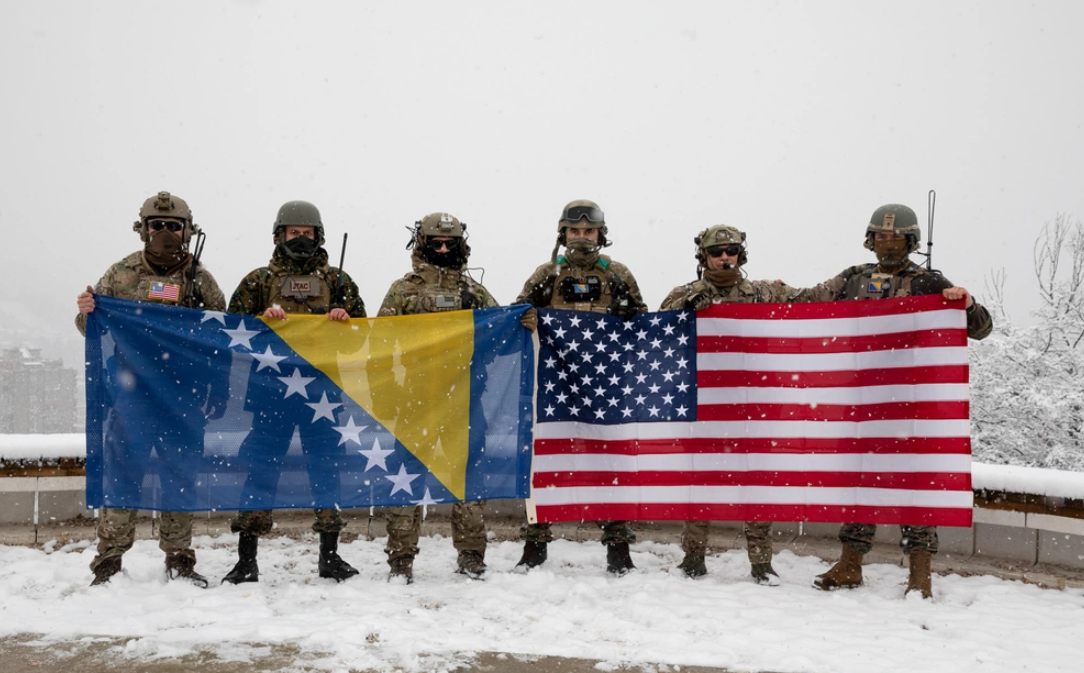
US, Bosnian soldiers, joint exercise, 2024. (Alejandro Lucero / DVIDS)
Jasmin Mujanović
24.01.2026. 05:05
Ovaj članak dostupan je na bosanskom jeziku
The U.S. has made clear that it considers the construction of the Southern Interconnector gas pipeline its chief policy priority in Bosnia. To date, the U.S. Embassy in Sarajevo has promoted the involvement of the newly incorporated “AAFS Infrastructure and Energy LLC” and the multinational conglomerate Bechtel as two potential partners in the realization of this project. Other firms may yet offer bids of their own, but the Americans clearly want this project for themselves.
That position has several implications for Bosnia’s strategic orientation. It is worth unpacking these clearly.
First, although only about 3% of Bosnia’s overall energy is provided by natural gas, virtually the entirety of this amount originates in Russia. Given Moscow’s practice of weaponizing gas dependency, and its overt support for the SNSD, HDZ BiH and other anti-state elements, there is a clear and present need to decouple the country’s energy infrastructure from Russia.
Second, energy policy is a major bipartisan issue in the U.S. The Trump administration has significantly reorientated its regional policy away from its predecessors – especially with respect to its decision to lift sanctions against Kremlin-backed secessionist Milorad Dodik – but it is continuing their focus on the Southern Interconnector initiative. In fact, it is signaling that its interest in Bosnia’s energy sector extends beyond this particular pipeline.
Third, Bosnia has historically lacked any meaningful commodity or resource that the U.S. genuinely wants. The possibility of securing major American investment in the country’s economy is thus a generational opportunity to cement the relationship between Washington and Sarajevo.
It is readily apparent then that Bosnia has a strategic imperative to pursue this project with the assistance of the U.S. But it also has an obvious need to negotiate aspects of the same.
To begin with, given that Bosnia’s chief interest in the Southern Interconnector pipeline is to ease its dependence on Russian energy sources, it should use this opportunity to eject, to the greatest degree possible, any Russian proxy influence over the country’s energy supply.
Unfortunately, as the president of AAFS Infrastructure and Energy LLC, Joseph Flynn, is the brother of Michael Flynn, a registered consultant of Milorad Dodik in Washington, DC who in turn appears to have had significant influence over the U.S. decision to lift sanctions against Dodik, the firm is not a sensible contracting choice for Sarajevo.
In contrast, although Bechtel has been at the center of a number of regional procurement scandals, it is an experienced and successful U.S.-based multinational construction firm. In that sense, it has the profile of a preferred partner for the Bosnian authorities.
Of course, Bechtel’s ultimate suitability for the Southern Interconnector project, and all associated energy projects in the country, should be established through a transparent bidding process and with respect to its ability to partner with BH Gas to deliver the construction of these in a timely fashion. Ideally, as the U.S. Embassy has gestured at, such a process would also be coupled with broader legislative reforms that will streamline foreign direct investment in Bosnia. The latter also has the benefit of ensuring that regardless of who controls the White House in the years to come, there will continue to be a vested, bipartisan American interest in Bosnia’s energy sector.
The same policy – engagement with established American corporate partners able to work with both Republican and Democratic administrations – should be pursued by Sarajevo with respect to every other potential U.S. investment initiative in the country, whether it concerns the construction of new power plants or the privatization of the Sarajevo and Mostar airports.
Above all, however, Sarajevo must prioritize deepening its existing links with American investors. Among these, Regulus’ stake in munitions manufacturers Pretis and Binas is far and away the most important, especially with respect to Bosnia’s aspirations for NATO membership.
It is apparent that Virginia-based Regulus wants to acquire a majority stake in both firms, and thereby significantly expand their production capacities. Such a development would center Bosnia’s defense industry in the global munitions trade and provide the country with a genuine strategic argument for its admittance into NATO: its ability to produce significant quantities of critically needed munitions, at a rate far above that of much larger allied countries.
A successful partnership with Regulus would not only boost Bosnia’s cache in Washington, but it would also have a compounding effect, benefiting Sarajevo’s broader defense-industrial potential. For instance, while Bosnian small arms production has been growing in recent years, its capacity to producer larger caliber weapons – like BNT’s proposed self-propelled Howitzer –remains stunted by a lack of capital investment. The country’s entire defense sector is also vulnerable because Bosnia no longer produces its own gunpowder, leaving it dependent on imports from hostile neighboring regimes.
Given that Regulus alone has proposed a $100 million investment to modernize Pretis’ production capacities, the play for any sensible Bosnian official here is straightforward: allow Regulus to take a majority stake in Pretis and Binas, leverage their capital and interest to resume domestic gunpowder production and other strategically significant manufacturing, and combined with U.S. investment in the country’s energy sector, make Bosnia the easiest place in the Western Balkans for American companies to do business.
That will mean jobs, and that will mean security. And for any politician or coalition in Bosnia which can realize that program, it will mean reelection.
O autoru

Jasmin Mujanović
Jasmin Mujanović je bosansko-američki politolog, autor nekoliko knjiga.
Više od istog autora