Canadian citizen Nickolas Ribić traveled to Bosnia and Herzegovina during the war, reportedly to participate in what has been described as a “Sarajevo safari,” a deadly pastime targeting civilians, according to Istraga.ba.
Canadian of Serbian Origin Came to Sarajevo for a ‘Sniper Safari’
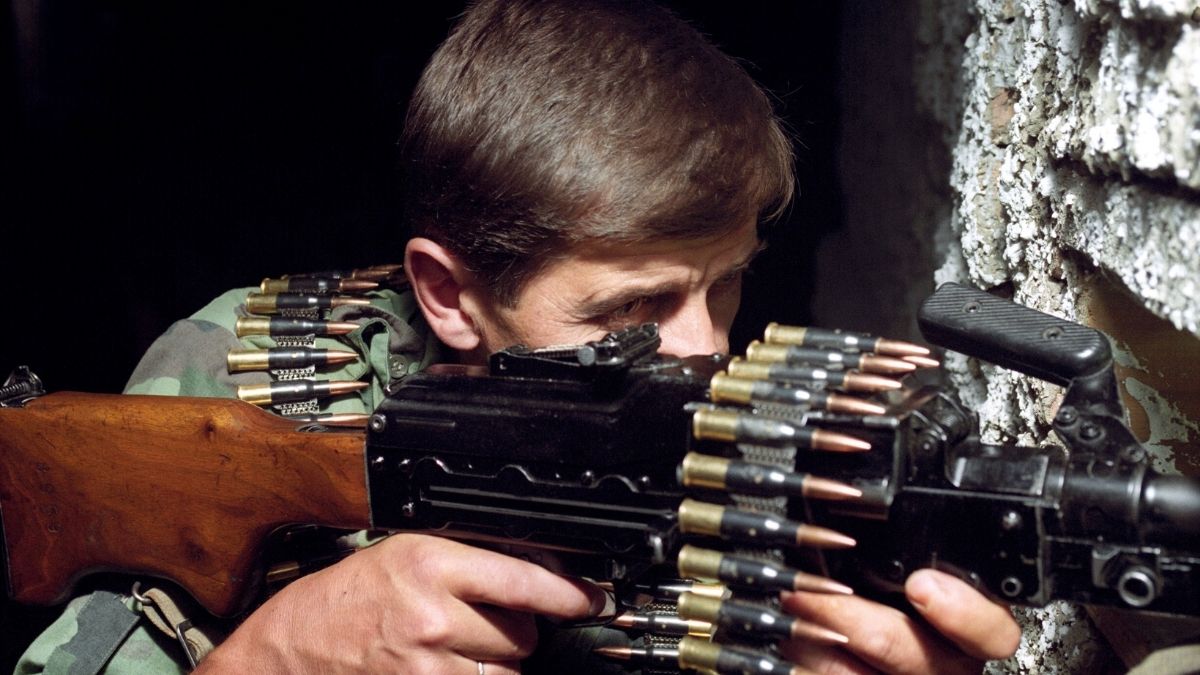
Bosnian Serb soldier holds his heavy machine gun ready, looking towards Bosnian army's positions in Grbavica suburb of Sarajevo, Bosnia And Herzegovina, 07 August 1993. (Foto: EPA/ENRIC MARTI)
!Odgovor
17.11.2025. 12:31
This information was confirmed by protected witness C-017 during the trial of Slobodan Milošević at the International Criminal Tribunal for the former Yugoslavia (ICTY) in The Hague, in a public session on June 11, 2003.
“He came on a safari, to hunt people,” the witness stated when asked if he knew Ribić. The witness explained that Ribić, also known as “Canada,” was a member of the paramilitary unit White Wolves. Ribić had arrived from Canada as a volunteer, wearing a full Bosnian Serb uniform and armed.
When asked by prosecutor Hildegard Uertz-Retzlaff if he had information about the activities of Nikolas Ribić, the protected witness C-017 responded:
“Yes. Nikola Ribić, also known as Canada, was a member of the White Wolves.”

Further questioning confirmed that Ribić had traveled directly from Canada to Bosnia as a volunteer. C-017 added that he found Ribić in the White Wolves unit but did not know where he had been prior to that.
Who is Nickolas Ribić
Born in 1974 in Canada to a family of Serbian immigrants, Ribić gained notoriety in 1995 when, during NATO airstrikes on Bosnian Serb positions, he captured UNPROFOR personnel and used them as human shields.
He became the first Canadian prosecuted for a kidnapping committed outside Canada. Ribić was charged under a previously unused stipulation of Canadian criminal law, which allows Canada to claim jurisdiction over kidnappings abroad involving Canadian citizens, whether as perpetrators or victims.
Ribić’s hostage was also a Canadian, Captain Patrick Rechner, an unarmed UN military observer in Bosnia. In May 1995, a photograph of Rechner, bound to a lightning rod at a munitions depot in Pale, circulated globally. Ribić, in Bosnian Serb uniform and armed with an AK-47, posed alongside other Serbian soldiers.
The hostages were taken to a Serbian base south of the city, where Rechner was tied in front of a munitions storage building. Ribić reportedly called the UN to warn: “Three UN observers are at the site. If there is further bombing, they will be the first.” The detainees were reportedly treated well and voluntarily returned to the UN office on June 18.
Rechner was held for 24 days, and the photo became a symbol of the UN’s inability to respond to Serb offensives.
In 2000, the Royal Canadian Mounted Police located Ribić in Germany and arrested him in February. He was extradited to Canada nine months later, with D’Arcy DePoe as his defense attorney.
Ribić’s trial began in Ottawa, Ontario, on October 8, 2002. However, three months later, on January 20, 2003, Ontario Superior Court Justice Douglas Cunningham declared the trial invalid after only nine days of testimony.
He was retried in 2005 for kidnapping and alleged death threats. Ribić’s attorney described it as “one of the most unusual criminal proceedings in Canadian history,” since a Canadian was being prosecuted in this way for the first time. Ribić was sentenced to three years in prison. Two Canadian Forces witnesses, identified only as Witness A and Witness B, testified via transcript.
In 2008, Ribić appealed to the Ontario Court of Appeal, arguing against the use of transcript testimony. The court rejected the appeal, concluding that Ribić had no connection to the munitions depots that would justify his claims, and the handling of Witnesses A and B had been appropriate.

Sarajevo Safari
During the siege of Sarajevo, wealthy foreign nationals, known as “sniper tourists,” reportedly came to the city and shot civilians for amusement. This phenomenon was investigated by the Milan prosecutor’s office after Italian journalist Ezio Gavazzeni submitted documents and testimonies collected over years of research.
Gavazzeni reported that Italian “sniper tourists” were guided by local soldiers to key positions and targeted civilians. The phenomenon has been documented in the film Sarajevo Safari by Miran Župančić.
American firefighter John Jordan, who worked in Sarajevo during the war and was wounded in 1994, also recounted the presence of foreign snipers in his testimony at the ICTY. Jordan described how the snipers deliberately selected victims, often targeting young family members, which inflicted severe psychological and social trauma on civilian communities.
These testimonies highlight that foreign volunteers were well aware of civilian vulnerabilities and intentionally exploited them for tactical and psychological effect in the besieged city.
The English version of this article, originally written in Bosnian, was translated with the assistance of artificial intelligence.
O autoru

!Odgovor
Svjesni da je živi dijalog istinski ravnopravnih sagovornika temelj razumijevanja i postizanja općeg dobra, platformu nudimo svim zainteresiranim autorima, organizacijama i grupama koje dijele naše osnovne ciljeve.
Više od istog autora