The Terminal Passivity of the Bosnian Body Politic
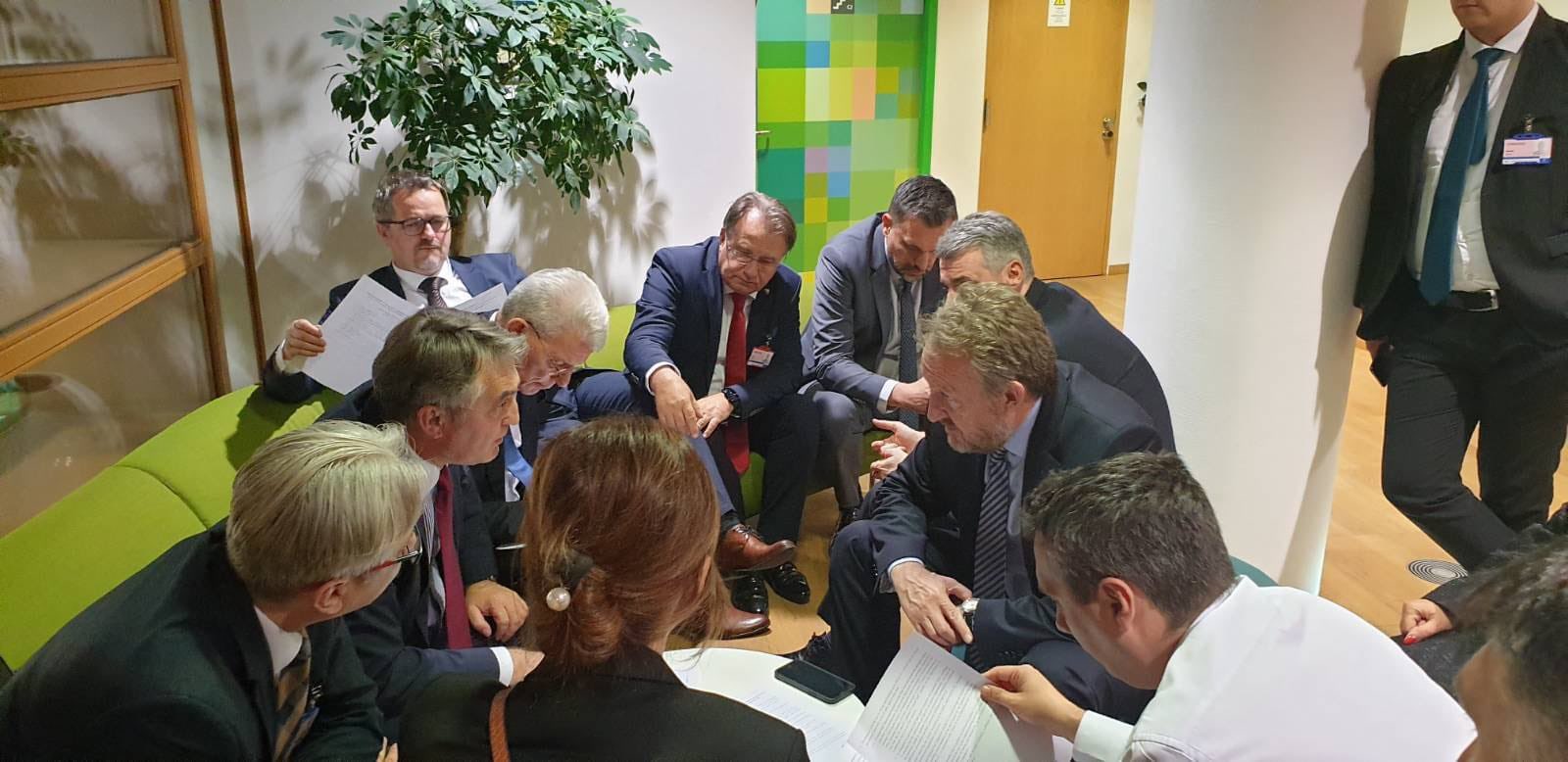
Najvažniji bosanski politički akteri u Briselu 2022. (Foto: X.com)
Jasmin Mujanović
08.11.2025. 04:44
“Paradoxical undressing” is a curious medical phenomenon during which a person experiencing severe hypothermia begins to undress. We do not fully understand the cause of this behavior, but medical scientists believe it is related to erratic blood flows that occur when our muscles begin to succumb to severe cold. And it is sometimes accompanied by “terminal burrowing” wherein the person experiencing hypothermia may seek small, enclosed spaces to aid their body’s warming. As these are both extreme reactions to extreme bodily stress, death typically follows.
Incomprehensible, hidden, afraid. These terms can also describe the present state of the Bosnian and Bosniak body politic. A body politic which is exposed to one systemic shock after another but is unable to articulate a rational response, even for the purposes of its basic self-preservation.
Consider the news cycle in BiH over the past two weeks.
Still reeling from the shock of the US decision to lift its entire sanctions architecture against secessionist Milorad Dodik and his regime, Bosnians learned on Tuesday that the BiH state prosecutor, a Dodik cadre, was also suspending all investigations against Dodik, and two of his close collaborators, for a separate set of charges related to their acts against the country’s constitutional order.
Simultaneously, the BiH Council of Ministers appointed Dragan Andric, another preferred candidate of both Dodik’s SNSD and their partners in the HDZ BiH, as deputy director of the state police. Zoran Galic, his predecessor in the position and likewise HDZ cadre, remains, we believe, in exile in Croatia, on the run from a warrant for his arrest in BiH.
That same day, Bosnians also learned of early morning police raids on several individuals closely tied to the Prime Minister of the Federation entity, Nermin Niksic. This followed revelations by investigative outlet Istraga of damning evidence showing that the Prime Minister had unlawfully directed the appointment of persons within the police services of the entity, and that anti-corruption authorities had known about the same for months and not acted.
Days earlier still, Bosnians had also learned that police officers and a former lawmaker in Tuzla were engaged in the sex trafficking of minors who were in the public child welfare system. And then came the horror of the deadly inferno at the senior’s home in Tuzla.
In virtually any other democratic polity, any one of these “affairs” would have resulted in the fall of national and local governments. It would almost certainly have resulted in significant public mobilization demanding the same. In BiH, it has resulted in neither.
There are some rational, historical reasons for why BiH has a weak protest culture. There are also some rational, historical reasons for why the Bosniak political elite, specifically, gravitates towards accommodation rather than conflict, even with those pursuing the destruction of the state.
But sustaining sympathy for the seeming passivity of the Bosnian public is increasingly difficult when one adopts a marginally broader lens.
Serbia is in the grips of a year-long anti-government mobilization, following a canopy collapse in Novi Sad. Georgians have likewise been in the streets for over a year, following widespread allegations of systemic election fraud in October 2024. Whatever differences may exist between these countries and BiH, there are a great deal of historical similarities between them too. And one could easily argue that Georgia’s overall geopolitical situation is significantly more precarious than that of BiH. And yet its citizens are on the streets, Russian military occupation and all.
Nor can one argue that the Bosnian public flex their democratic muscles at the ballot box. In 2022, only 51.45% of eligible voters participated in the general elections. In Georgia in 2024 60.2% of voters did so. At the 2023 Serbian parliamentary elections 58.77% of voters participated. In Moldova, another weak European democratic polity in a hostile neighborhood, the 2025 parliamentary elections saw a 52% turnout.
Are BiH’s elections free and fair? Not quite, and the 2022 elections saw unprecedent electoral engineering on the part of High Representative Christian Schmidt. But neither are Serbia and Georgia’s elections free, and the public still participates at a higher rate than in BiH. And they take to the streets when they are upset at their government. The Bosnian and Bosniak publics do neither.
The point is simple: the political situation in BiH is dire, and it is getting worse. Neither the political class nor the public are reacting with anywhere near the level of urgency – or just competence – required to address the current, very possibly terminal, trajectory for what remains of the BiH state and its rule of law.
There are 12 months left until the 2026 BiH general elections. Now is the time to organize a coherent democratic program which can motivate the (non)voting public, in BiH and in the diaspora. It is also time for the public itself to organize their ranks and demand of their elected officials the articulation of a coherent, actionable agenda for BiH’s near and long-term future.
This is not some grand utopian appeal. It is the most elementary expectation one should have of any people and their leaders who claim to aspire to democratic self-rule.
Dr. Jasmin Mujanović is a Senior Non-Resident Fellow at the New Lines Institute and the author of the books “Hunger and Fury: The Crisis of Democracy” and “The Bosniaks: Nationhood after Genocide”.
O autoru
Jasmin Mujanović
Jasmin Mujanović je bosansko-američki politolog, autor nekoliko knjiga.
Više od istog autora