The results of the parliamentary elections in Serbia are a political earthquake for the Western Balkans. Few seasoned observers truly believed the Student List could top Aleksander Vucic’s entrenched SNS regime, which had governed the country for nearly fourteen years, and fewer still – if anyone, at all – believed Vucic would so readily concede defeat.
Serbia’s Democratic Example
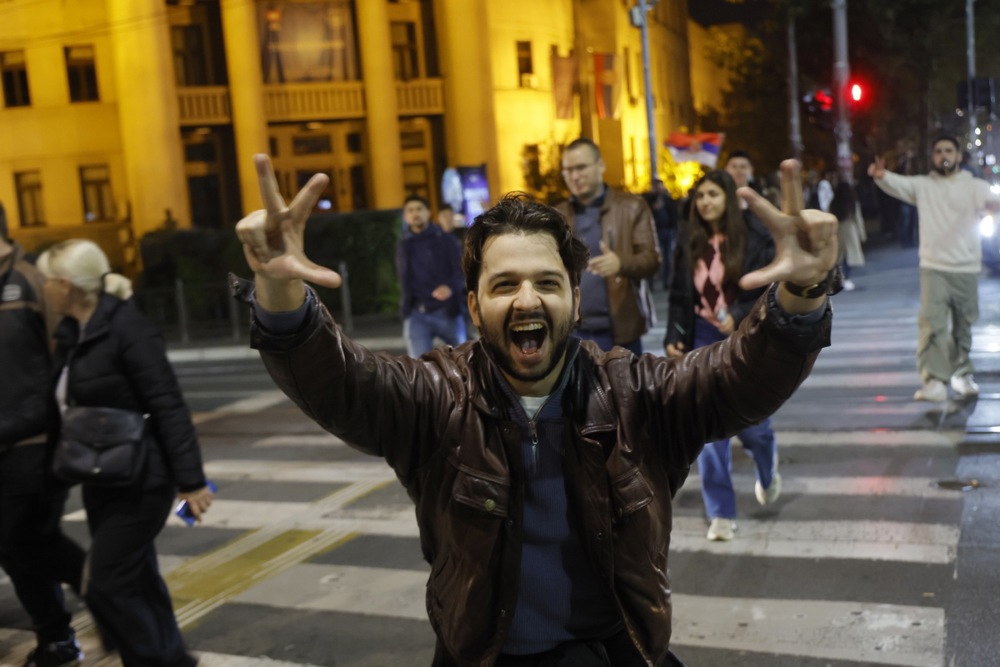
Slavlje na ulicama Beograda nakon izbora (Foto: EPA)
Jasmin Mujanović
26.10.2026. 08:23
And yet that is precisely what has happened.
As the euphoria in Serbia’s streets winds down in the coming hours, the tough work of governing will fall to the newly elected Student List government. According to the preliminary results, the Student List will have a comfortable governing majority in the country’s National Assembly, with some 135 to 140 delegates based on the current count. Vucic’s SNS will have a sizable minority still, with over 100 of their own members in the body and will likely seek to impede the new government at every step, especially ahead of the presidential elections in December.
As Serbia settles into its new reality, two takeaways are relevant for the broader region.
The first is a frequent refrain but is also simply an unassailable truth. Change requires participation. Citizens who do not participate in the democratic process – not in the public square through protest and engaged debate, nor through the ballot box – will achieve nothing. Non-participation is not an option; boycotts of the electoral process are doomed to failure (as Serbia itself saw in 2020). Any transformation in society requires, first and foremost, the public to mobilize to demand it; and then their persistent engagement to see it through.
There was a legion of reasons why the Serbian public should not have thought it possible to mobilize against the SNS regime. Vucic controlled the media, the electoral commission, the police, and the broader security apparatus, the oligarchs, and he could rely likewise on the (albeit meager) demographic support of the secessionist regime in Banja Luka.
It should not have been possible for Vucic and the SNS to lose, much as with Orban and his Fidesz clique. Yet both did. Why?
Because in Serbia the turnout was around 70%, and in Hungary it was nearly 80%. That degree of democratic participation is just too difficult to invalidate, even with the most earnest electoral engineering. There were too many votes against both regimes for their apparatchiks to be able to hijack the result. They tried, but they could not overcome the overwhelming force of the democratically mobilized masses.
In Bosnia and Herzegovina’s recent general elections, by comparison, the official turnout was under 45%. And who won? The two clearest winners, the SNSD and the HDZ BiH, have dominated the country’s politics for more than 20 years. And will dominate it for another four years at least. In other words, the vast majority of the Bosnian public did not participate in the democratic process, and therefore the existing establishment benefited. Even if we grant that the real turnout figure was somewhat higher than the official count – as it is widely understood that the voter rolls are unrealistically inflated – this is a distinction without a difference. The Bosnian public, in sum, failed themselves.
The second major implication of the Serbian elections concerns the political situation in the broader region. Local capitals will look for early signals from the new government in Belgrade to evaluate its foreign policy. Wil there be a new approach to Kosovo? What of the relationship with the secessionist regime in Bosnia’s smaller entity? And what about the Vucic-era attempts to re-colonize Montenegro, politically if not explicitly? These are important questions, but Podgorica, Pristina, and Sarajevo alike must temper their expectations.
The Student List is a heterodox coalition. We should not expect a 180-degree transformation in Belgrade’s foreign policy positions from a movement that bridged some of the most extreme elements of the Serbian right with its pro-European center, or whatever may constitute the Serbian political left. The (ultra)nationalist right, both the segments presently lined up behind the Students List and those that will remain aligned with the SNS, will remain a major factor in the country’s politics. Immediate, radical changes to Belgrade’s overall international orientation are unlikely, not least of all because that is just not the program the Student List ran on.
Still, this is an opening, and politics – especially in the Balkans – is a game of millimeters. Nearly every state in the region has legitimate grievances with Serbia and is justified in reserving judgment of this new order. But regional capitals should give the new government the opportunity to prove itself, all the same. And let us accept now already that the official rhetoric from Belgrade will likely be over the map ideologically, especially in the first few months, much as it was for the duration of the student protests.
But there is a real opportunity for quiet, unglamorous progress. For Sarajevo, even a modest chill in relations between Dodik and Belgrade may be enough of an opportunity to stabilize the political situation in Bosnia and Herzegovina. For Pristina, recognition of Kosovo’s sovereignty is not necessary if the new Serbian government can simply cease obstructing that country’s Serb community from integrating into Kosovo’s institutional order. And Podgorica would likely be happiest with a Serbia that will forget entirely about its existence.
The Serbian people have made a major decision. The entire region would benefit from a democratic, moderate Serbia. Sunday’s result may – or not – be its genesis. But let us at least give the Serbians a chance to finish what they have started. And ask, in the interim, what is required to create anything vaguely approximating similar mass-based democratic movements in other parts of the Western Balkans.
O autoru

Jasmin Mujanović
Jasmin Mujanović je bosansko-američki politolog, autor nekoliko knjiga.
Više od istog autora