Like a toddler who has discovered the family sweets stash without their parents knowing, Milorad Dodik is running on a nearly year-long sugar high. Since the October 2025 U.S. decision to lift its sanctions against him and virtually his entire secessionist regime, Dodik has flitted from one provocation to another. He has resumed his frequent threats to pull out of the Dayton Peace Agreement, he was present at the grotesque state-sponsored funeral of the genocidaire Ratko Mladic in Belgrade, and he lambasts European officials for their purported anti-Serb agenda on a nearly daily basis.
Dodik at the Boyne: Toddler Discovering Family Sweets Stash
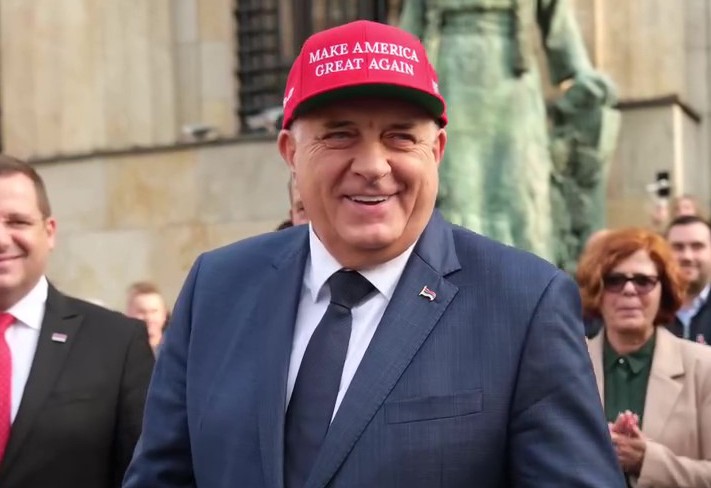
Foto: Ured Predsjednika RS-a
Jasmin Mujanović
15.09.2026. 06:25
He has even begun hinting that if both his SNSD and their allies in the HDZ BiH win their respective races for the Bosnian state presidency, Dodik expects to receive a pardon for his 2025 conviction which saw him removed from office by the Court of Bosnia and Herzegovina. After that he says he would assume the post of Prime Minister of the RS entity. And then a new political crisis in Southeastern Europe is upon us.
Peaceful Process, not a Genocide
It is all a bit manic, as best evidence by one a peculiar post made by Dodik on Monday.
Writing about President Donald Trump’s recent visit to Ireland, during which the American leader offered his (flippant) support for Irish reunification, Dodik argues Trump’s “view that the unification of Northern Ireland and Ireland would be the most natural development imaginable is visionary and fully consistent with the principle of peoples’ right to self-determination. If the German people were able to reunify, why should other peoples not have the same right?” He goes on to praise the leaders of Sinn Fein, Plaid Cymru, and the SNP for moving to sign “an agreement aimed at securing independence from the United Kingdom, [which] is a sign that the era of domination and colonization is drawing to a close.”
Dodik spews so much nonsense on any given day that fact-checking his various diatribes is not an effective use of anyone’s time. Still, his attempts to weigh in on the current round of constitutional debates in the UK are significant. Not as an expression of his well-worn anti-British attitude but as an attempt to make his secessionist agenda legible and comparable to the broader international community. And this should be addressed clearly.
First, a framing point. The processes unfolding in the UK, unlike those supported by Dodik, Vucic, and their Serb nationalist predecessors during the 1990s and since, are peaceful and democratic. If the citizens of the UK decide to re-configure their constitutional arrangements, they will do so through the ballot box – not genocide – as they did during Brexit. Or, for that matter, as they did during the initial round of devolution which gave Northern Ireland, Scotland, and Wales a greater say in local administration.
Moreover, in the case of Northern Ireland, both the republican and unionist sides are behaving within the contours of the 1998 Good Friday Agreement, unlike Dodik and Vucic with respect to the Dayton Peace Agreement. Not least of all because the former contains within it a formal mechanism for Northern Ireland to exit the UK and join the Republic of Ireland. No such clause exists in Dayton of course because the RS entity exists purely because of Serbia’s de facto invasion of Bosnia and Herzegovina in 1992.
Unlike Northern Ireland, which can at least trace its political lineage to Ulster, one of the four historical provinces of Ireland, the RS entity is exclusively the product of Milosevic and Karadzic’s aggression against Bosnia and Herzegovina. The RS entity thus has the same ‘historicity’ as the Donetsk People’s Republic or Transnistria; it is an occupation regime, which gained all of its subsequent legality purely through the signing of the Dayton Agreement and therefore with the explicit rejection of any political status outside the Bosnian state and outside of the peace agreement. In fact, that point was critical to the Dayton negotiations – that the RS entity has no political or legal pathway towards secession – which was further cemented by the entity’s bifurcation into two, non-contiguous portions by the establishment of the Brcko District. It has also been reasserted as a political fact by generations of American and European administrations and governments since 1995.

Who Is the Colonizer?
Secondly, Dodik’s reference to the “unification of the German people” is especially illustrative, despite the lack of clarity as to what he is referencing. To begin with, the process of German unification which resulted in the 1871 Treaty of Frankfurt and the establishment of the German Empire only lasted until 1918. The Weimar Republic which followed likewise collapsed quickly, and of course Hitler’s attempt at pan-German unification and domination over Europe failed as well. German reunification in 1990 saw West Germany and East Germany combine to create the contemporary Federal Republic of Germany but today there are still another five sovereign European states with significant German-speaking communities. Given the historical experience of the RS entity, the only coherent parallel to what Dodik appears to be hinting at is Nazi Germany’s occupation of the Sudetenland and the subsequent “Anschluss” with Austria. That is, narrowly defined ethnic-majoritarianism as license for territorial expansionism (i.e. Hitler’s Germany, Milosevic and Vucic’s Serbia). Modeling one’s politics on Nazi Germany is hardly a means of winning hearts and minds in international affairs, but Dodik is clearly convinced it is the wisest way forward.
Thirdly, there is the still more bizarre reference to “colonization”. Only one contemporary Western Balkan state has engaged in a discernable pattern of colonization of its Western Balkan neighbors, and only one has ever styled itself as an empire: Serbia. That process was, arguably, most evident in Kosovo and Macedonia after their seizure by Serbia during the Balkan Wars (1912-1913) but also readily apparent in the union Belgrade forced with Montengro and Vojvodina in the wake of World War I. As North Macedonia, Montengro, and Kosovo have all (re)claimed their sovereignty, ‘de-colonization’ as a conceptual framework in the region only makes sense with respect to Serbia’s continued dominion over Vojvodina.
In contrast, its only possible application in Bosnia is with respect to the historic settlement of Orthodox Christian communities along the Krajina borderland by both the Habsburg and Ottoman imperial authorities, and the later process of Bosniak land expropriation by the Serbian-Yugoslav crown. In present-day Bosnia, a ‘de-colonial’ approach to the country only makes sense as a process of constitutional reform that would see the country adopt truly indigenous (and rational) administrative apparatus in line with the European Convention on Human Rights, the opinion of the Venice Commission, and the EU acquis. In other words, Bosnia’s political-democratic reintegration, rather than its further fragmentation, led and directed by Bosnians themselves; not generals in Belgrade or Zagreb, or unelected bureaucrats in Brussels.
Of course, the only people who have seriously floated the independence of Vojvodina in recent years are Vucic himself, and his associates in the erstwhile Orban regime. Much as the idea of secession of the RS entity is almost wholly a project of the SNSD, and their patrons in Belgrade, and appears to enjoy only limited support among Serbs in Bosnia as such. A 2021 poll by the National Democratic Institute found 45% of residents of the RS entity opposed its secession, against 35% of those who supported it. And fully 72% agreed that the priority of political leaders should be avoiding renewed inter-ethnic violence.
In sum, Dodik’s claims are, as usual, incoherent and historically illiterate. But because he is evidently testing out a new narrative approach to his well-worn extremist aims, it is important to cut him off at the pass. Or lock up the candy drawer, if you will.
O autoru
Jasmin Mujanović
Jasmin Mujanović je bosansko-američki politolog, autor nekoliko knjiga.
Više od istog autora