America’s 250th anniversary of independence stirs many memories within me.
America at 250: Between the Ideals of Jefferson and the Reality of Today
Screenshot
Fuad Đidić
09.07.2026. 10:10
My first encounter with America did not take place at a New York airport or beneath the lights of one of its great cities. Paradoxically, it happened in the very heart of Sarajevo.
On the corner where Musala Street meets Obala, next to the former Sutjeska Cinema, the American Information Center opened sometime in the autumn of 1976.
For us, it was an important event. It felt as though the opening of the Center heralded a new era for Bosnia. Throughout that decade, our republic fought tenaciously for equal status within the Yugoslav federation. We welcomed the fact that, through everything the Center offered, Sarajevo’s character as a globally recognized city was being strengthened through ever-closer ties with the Atlantic world.
The Scent of Modernity
Simply walking into the Center was, for me, a special experience. Everything inside seemed to carry the scent of modernity, freedom, and fascination with life in that distant country.
I vividly remember the large display featuring Thomas Jefferson, the author of the American Declaration of Independence, beneath which appeared the words written 250 years ago:
“We hold these truths to be self-evident: that all men are created equal, that they are endowed by their Creator with certain unalienable Rights, that among these are Life, Liberty and the pursuit of Happiness.”
I also remember a specially designed corner devoted to American basketball, with large panels celebrating the sport and its stars. Basketball, as an urban game, was part of America’s identity. Those images became my first powerful and enduring connection between America and Sarajevo—especially during the city’s finest sporting moment, when Basketball Club Bosna won the European Championship in France in 1979.
As a young and curious philosophy student in Sarajevo, I was captivated above all by the atmosphere of American ambition, energy, and the ever-present image of success and achievement. I understood America through the words of Jefferson, Adams, Franklin, and Washington—that all people are created equal, and that America was a refuge for people around the world seeking success, freedom, and a better life.
Those ideals forged an especially strong bond between me, as a Bosnian, and America.
Tradition and Counter-Tradition
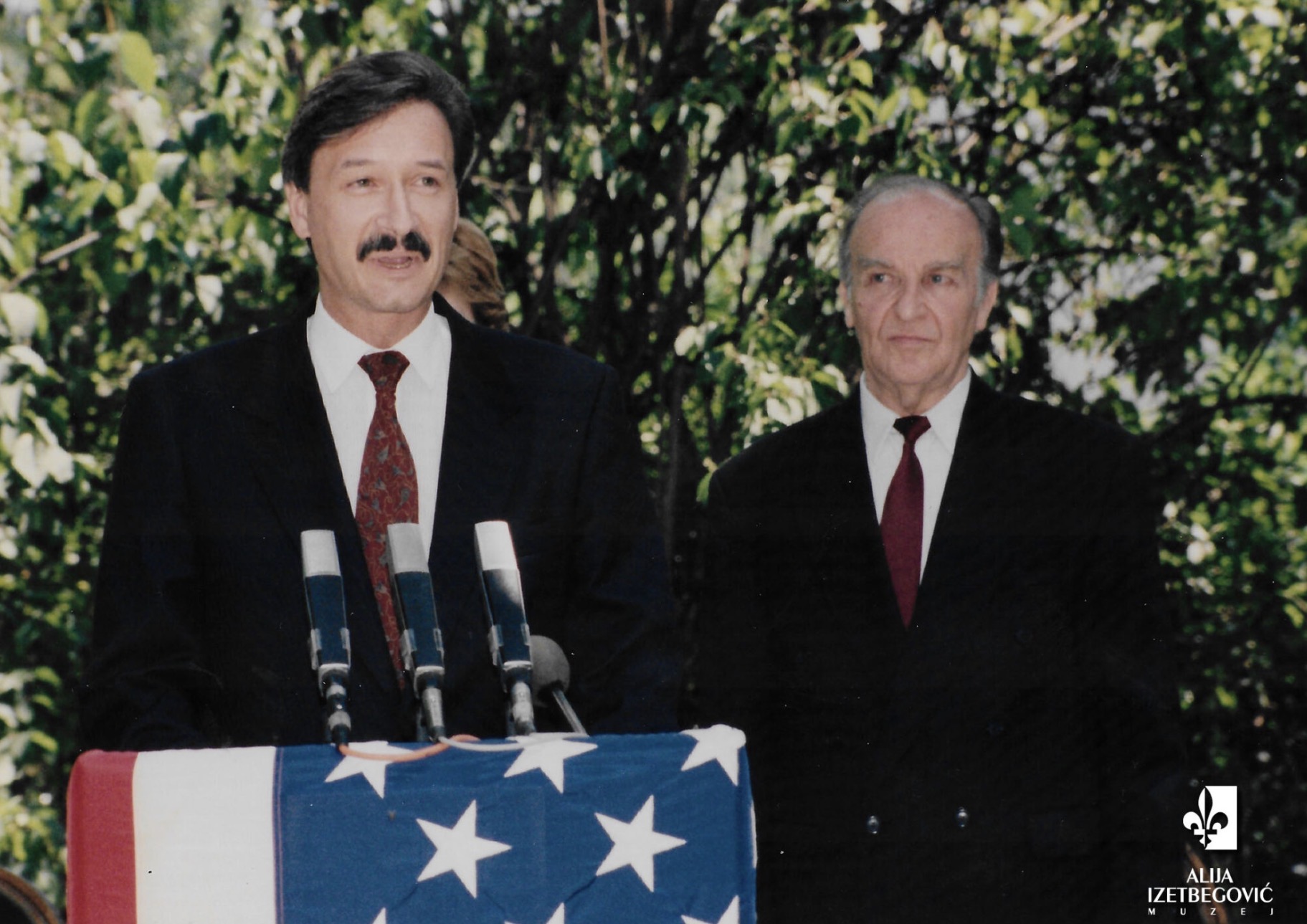
By an irony of fate, the first director of the American Center was Victor Jackovich.
Years later, he would become the first United States Ambassador to Sarajevo after the Clinton administration decided, despite the siege of Sarajevo, to open the U.S. Embassy in Bosnia and Herzegovina in April 1994 on Alipašina Street.
Jackovich himself was the child of immigrants to America—precisely the kind of people who had found far greater freedom and prosperity in the New World. Even today, we remember him as an exceptional man and diplomat shaped by an American culture of universality and solidarity shared among immigrants, without any claim that one group was inherently superior to another.
Yet today, half a century later, this great American anniversary evokes very different emotions.
Questions multiply—questions for which I have no answers.
The image of America that once inspired fascination and hope now finds itself dangerously confronted by the brutal political reality of naked power, racism, and astonishing ignorance.
It is difficult to remain indifferent.
For those of us in Bosnia who embraced America’s universal vision, the past decade has been marked by a profound sense of ambivalence. As time passed, we began to discover that alongside America’s traditional openness there existed another tradition—its opposite.
It became increasingly difficult to ignore signs of carefully packaged xenophobia, disturbing arrogance, and a harsh political coarseness embodied with remarkable transparency in Sarajevo by former U.S. Ambassador Michael Murphy.
Yet despite everything, it was impossible overnight to abandon—or erase—the deeply rooted conviction that America had been founded upon ideals that became the cornerstone of its nation and culture, influencing countless countries throughout the world.
Then history confronted us with another paradox, one that arrived unexpectedly.
We have experienced this paradox most painfully over the past two years.
Unofficial America
At a moment of profound political crisis in Bosnia and Herzegovina, several influential figures entered the country’s political life in a particularly harmful and malicious way.
All of them were Americans.
More tragically still, they were all descendants of immigrants from this region whose families had come to America seeking freedom from oppression or poverty.
Strictly speaking, they did not represent official America, but rather an unofficial America—the America of informal political visions held by ordinary citizens angered by what they perceive as their country’s declining power and influence in the world.
Nevertheless, their influence left its mark on Bosnia’s political drama, at times even overshadowing the work of American diplomats in Sarajevo.
Their names deserve recalling.
First came Olga Ravasi, an amateur intelligence enthusiast who emerged as a candidate for ambassador to Sarajevo.
Then came Max Primorac, a senior member of the Heritage Foundation in Washington.
Finally came Rod Blagojevich, the former governor and congressman.
Children of immigrants—but also merchants of poison in the homeland of their ancestors.
All of them, whose families had sought equality and freedom from oppression in America, found refuge beneath the grand vision set forth in Jefferson’s Declaration 250 years ago.
Yet somehow they now return to Bosnia as crusaders—as warriors claiming to defend endangered Christian minorities, determined to defeat or eliminate the Muslim majority in Sarajevo, a city they portray as endlessly producing mujahideen and holy warriors.
They arrive at the invitation of political actors from Banja Luka or Mostar to manufacture conflicts where no genuine threats exist.
Islamophobic Slanders
The zealously radicalized Olga Ravasi wrote Donald Trump a lengthy and deeply venomous letter last year, filled with hatred and contempt toward an elderly Bosnian woman known as Nana Fata, whom she described as an “Allah warrior.”
Rod Blagojevich, himself a convicted former governor, claimed that Iran exports radical Islamists into the Federation of Bosnia and Herzegovina.
Then there is Max Primorac, the descendant of Herzegovinian immigrants, who warned that political Sarajevo risks “the wrath of the Donald Trump administration” if it continues what he called the “repression of its Christian neighbors.”
Appearing before the U.S. Congress, Primorac described Bosnia and Herzegovina as a failed state.
In what the author characterizes as the style of an extreme Islamophobe, he attacked Bosnian citizens advocating a normal, European, civic state, accusing them of seeking domination over supposedly endangered Christians—especially Croats.
What has become of America 250 years after Jefferson proclaimed that all people are created equal?
Who are Primorac, Blagojevich, Ravasi, and others like them?
Are they loyalists shaped by the culture and racial ideology of the Republican administration and President Trump?
Or are they merely paid advocates for Milorad Dodik or Dragan Čović—empty personalities seeking compensation for lost dignity and quick fame to redeem unsuccessful lives?
To what do they owe such fierce hostility toward Bosnia, and particularly toward Bosniaks?
Is it loyalty to Trump’s MAGA movement and its evangelical certainties?
Or commitment to ideological remnants of Serbian and Croatian fascism from which their own ancestors once fled across the Atlantic?
Can the America we now see through these descendants of immigrants—people whose own families found salvation in the Declaration of Independence—still credibly lead the world in the twenty-first century?
Can highly placed analysts and intelligence figures such as Primorac or Ravasi genuinely serve as role models of pluralism or represent an America that insists it is founded upon cosmopolitanism and respect for humanity?
A Democratic Empire
History has known many empires.
But the world has never known an empire so vast, so deeply interconnected, and at the same time so democratic—or one built upon such a universal vision—as the America envisioned in the principles of the Declaration of Independence.
For that reason, figures whom we see as political arsonists and propagandists of hatred and the dismantling of Bosnia and Herzegovina compel us to ask whether today’s America is still capable of defending the ideals of successful integration among people of different religions and nations, and of safeguarding the freedom of its citizens.
Or are Ravasi, Primorac, and Blagojevich merely the visible tip of a much larger iceberg—a deeply divided America that has lost mutual respect within its own society, lost respect for the identities of other peoples, religions, and nations, and in doing so increasingly breeds distrust toward the very ideals that once promised refuge for the oppressed and persecuted?
Can America still recognize and defend international models of coexistence, such as that of Bosnia and Herzegovina?
On the occasion of its 250th anniversary of independence, will America once again accomplish what once seemed impossible?
Will it once again lead?
Will it be first—but in a different way?
In the way we first came to know it through other immigrants and their descendants—
through people like Victor Jackovich?
O autoru

Fuad Đidić
Fuad Đidić, raniji diplomat, publicista i autor, član „Kruga 99“. Autor više recenzija, knjiga i radova i komentara za štampu u Kanadi i Australiji. Uspješno realizirao projekat izgradnje ambasade BiH u Canberri, Australija ( 2001). Član paneuropskog pokreta „Diem25“
Više od istog autora