When the Trump administration decided to lift virtually the entire American sanctions regime against the Bosnian Serb secessionist authorities in Banja Luka in October 2025, the U.S. press – accurately – portrayed the move as a major concession to a key Russian ally in the Western Balkans.
Why did the U.S. Save a Chinese Client Regime from Self-Implosion?
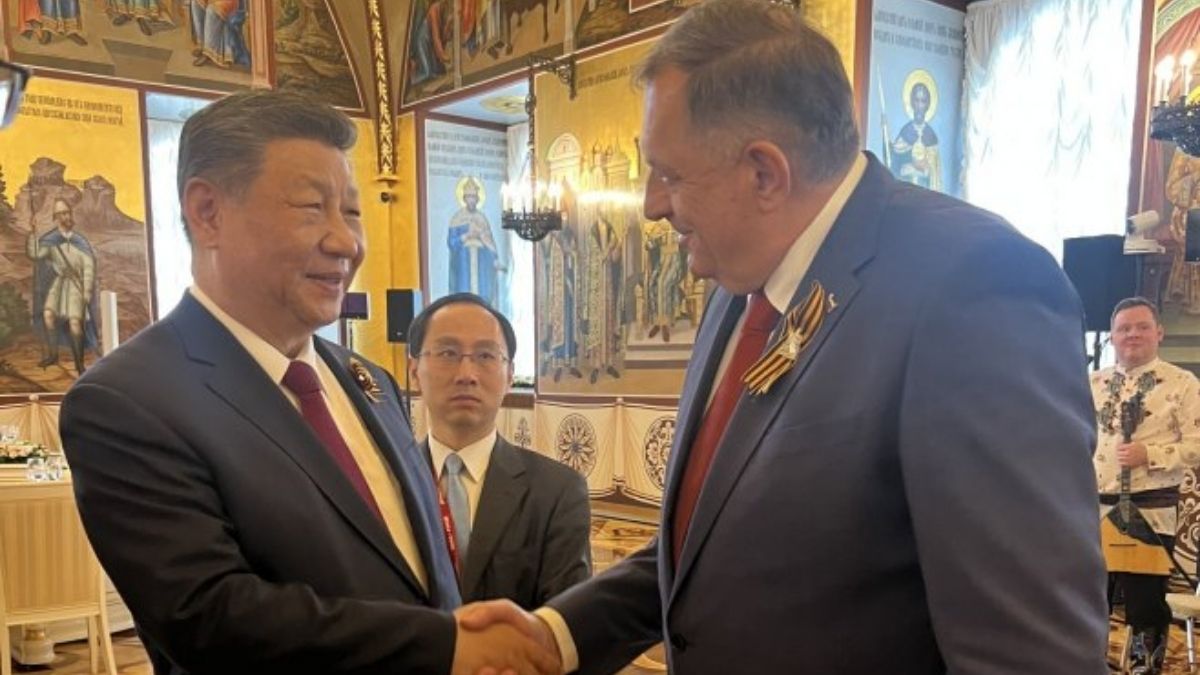
Milorad Dodik razgovara s predsjednikom Narodne Republike Kine Xi Jinping nakon vojne parade u Moskvi, 9. maja 2025. godine. (Foto: RTRS)
Jasmin Mujanović
03.07.2026. 11:06
That framing reflected the ‘hook’ through which the American press had interpreted Milorad Dodik’s tenure in Bosnian politics, and its relevance to their audience: he was a Kremlin ally, stirring up trouble in the Balkans, a region still largely synonymous with the wars of 1990s (and perhaps even the onset of World War I) in the popular Western imagination.
Banjaluka’s close alignment with Moscow
Of course, both the first and second Trump administration, and their preceding campaigns, had made their desire for a reset of U.S.-Russia ties transparently clear. Thus, aside from the tens of millions of dollars Dodik spent lobbying the White House for a reversal of longtime bipartisan U.S. policy in Bosnia and Herzegovina just since 2024, arguably his greatest advantage in his overtures to the Trump administration was a degree of obvious ideological and practical symmetry between the two sides, especially on the Russia file.
In short, Banja Luka is closely aligned with Moscow; Washington wants to reboot the relationship with the Kremlin; it follows that it would thus also pursue normalization with Russia’s proxies in the Western Balkans.
Alas, the truth, as Oscar Wilde famously wrote, is rarely pure and never simple.
While the Dodik regime has significantly politically capitalized from President Trump’s broadly dovish stance on Russia, it is Banja Luka’s far less well known but financially much more robust relationship with China that hangs both around the neck of Milorad Dodik, and those in Washington who believe that he and his regime can be completely rehabilitated as relevant partners in the region. Because they cannot, and attempting to so risks seriously undermining the U.S. posture versus China.
Consider the following cursory overview of the ruling SNSD regime’s entanglements with Beijing.
Serb nationalist project is financed by China
Since 2021 the RS entity government has consistently touted Chinese willingness to accept RS bonds as instruments of financing, as the entity has been increasingly shut out from nearly all other relevant loan mechanisms. Prime Minister Radovan Višković has travelled to Beijing to negotiate loans with three opaque Chinese funds just to service its €500 million debt repayments. The regime has significantly deepened the SNSD's formal partnership with the Chinese Communist Party, hosting the CPC International Department's Deputy Chief in East Sarajevo in 2023 and agreeing to annual party-to-party consultations.
The entity has also handed a sanctioned Chinese military-linked firm a €29 million contract to run security software across 780 public institutions. It has attempted to obscure its motorway concession with Shandong Hi-Speed, valued at nearly €300 million despite repeated court orders to provide greater transparency regarding the government’s procurement practices. The entity government has issued guarantees to China’s Exim Bank without legally required approval for Chinese-built hydropower plants. It has signed another enormous new motorway construction deals with the same financial institution. And in 2024 the government opened a new Sinopharm-built hospital at which Dodik personally thanked Xi Jinping and announced the construction of an additional Sinopharm campus for Banja Luka. The then RS health minister even boasted that the government was keen to see the expansion of traditional Chinese medical practices among local health care providers.
Were one to cross-reference these developments with the likewise aggressive entanglements between the government of Serbia (i.e. Dodik’s chief political patrons) and the Chinese communist regime, we would quickly arrive at the conclusion that much of the contemporary Serb(ian) nationalist project is (in)directly financed by China.
And what then is the American position with respect to this aggressively expanding influence of the Chinese communist regime in the RS entity?

The U.S. prevented the collapse of Chinese client regime
The U.S. decision to normalize ties with Dodik has convinced him that he now enjoys the backing of Washington, Moscow, and Beijing alike. As a result, Beijing and Banja Luka are now clearly incentivized to deepen their economic and political ties, and sharply so.
The previous American sanctions regime had pushed the Dodik regime to the brink of financial insolvency and political implosion. These measures were also significantly boosting the odds of a generational political transition in BiH’s smaller entity, with the long dormant Serb opposition parties finally achieving credible electoral results on the back of the SNSD’s evident political tailspin.
That opportunity has now been lost.
Worse, this reconstituted SNSD regime has in the interim become so beholden to Chinese financial and political interests, that it is essentially a Beijing client government. In other words, by reversing its sanctions policy versus Dodik et al, the U.S. has saved a Chinese client regime from collapse.
From the perspective of America’s contemporary grand strategy, the defining feature of which is its global, full-spectrum competition with communist China (its only genuine peer rival) the act of preventing a key Chinese proxy regime from self-imploding is utterly incomprehensible.
Pressure can be reapplied
The good news is that in comparison to most other zones of U.S.-China competition, BiH and the Western Balkans are still a relatively advantageous terrain for Washington to operate, notwithstanding recent unforced errors in policy. Sanctions can be reimposed, pressure reapplied, and a new collective strategy with NATO allies developed to push back Chinese influence in the RS entity and BiH.
But doing so will require the will and courage in Washington to recognize that the past two years of policy ‘innovation’ in BiH have failed, and that their only major output has been to strengthen the position of China in the Western Balkans. No one in BiH or any other regional capital can convince American policymakers of that fact, no matter how glaringly obvious it may be. They must recognize it for themselves because it is U.S. bipartisan national security priority.
O autoru

Jasmin Mujanović
Jasmin Mujanović je bosansko-američki politolog, autor nekoliko knjiga.
Više od istog autora