Bosnia and Herzegovina’s World Cup campaign, which has seen the country qualify for its first knockout stage match in only its second appearance at the tournament, is a remarkable sporting achievement. But it is the extraordinary outpouring of support for the squad from Bosnians, both in BiH itself and in from the country’s global diaspora, which is worth the most sustained attention.
The Team Changing a Nation’s Mentality
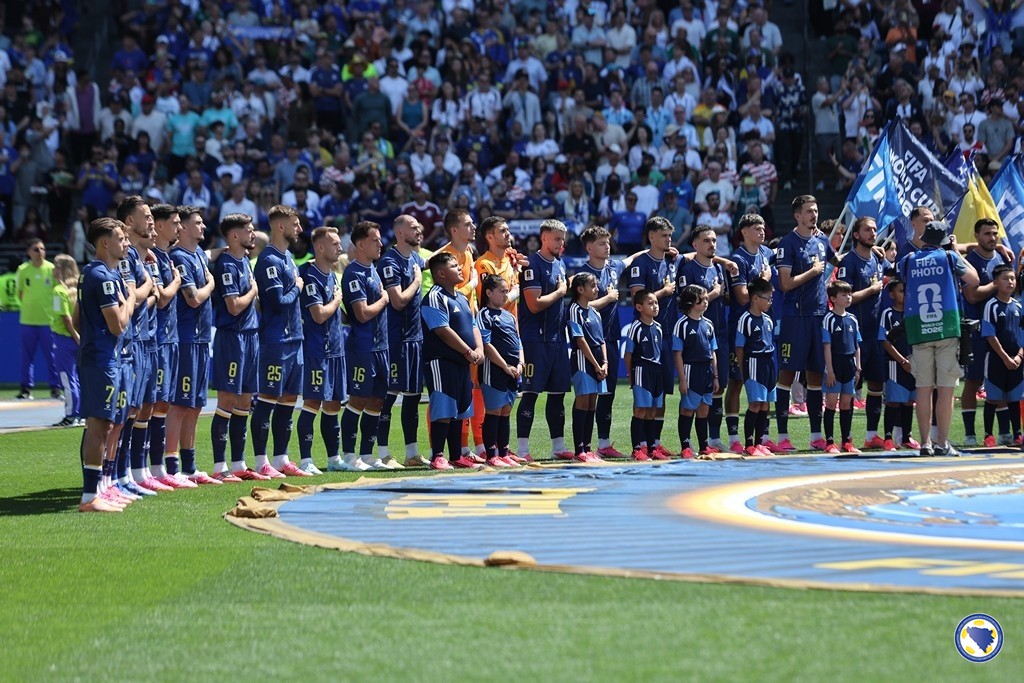
Foto: Nogometni savez Bosne i Hercegovine
Jasmin Mujanović
27.06.2026. 07:01
Tens of thousands Bosnian fans from all over the world attended the team’s three group stage matches in Canada and the U.S., with an estimated 30,000 to 40,000 Bosnian supporters packing the stands just in Los Angeles. Each match was also accompanied by a series of fan gatherings in the respective host cities, which saw Bosnian fans fill pubs and public parks to their brims, spilling out into the streets, singing, chanting, dancing.
Expression of defiance
The moment the Bosnian squad scored its first goal against Qatar during the decisive June 24 match which secured the team’s second round berth, fireworks began echoing throughout Sarajevo. Within moments of the game’s 3-1 finish, the streets of the capital, and towns and cities around the country, were filled with euphoric masses, who reveled in the team’s historic triumph into the wee hours of the next day.
Football is the world’s most popular sport, and the World Cup is the world’s premier sporting spectacle. A sport (in)famous for its intense fan following. But the joy Bosnians feel at their team’s success is not merely an expression of fandom. It is an expression of defiance.
For the Bosnian diaspora, the largest number of which resettled in the U.S. and Canada during and immediately after the Bosnian War, the sight of a squad of largely foreign-born players donning the blue and white of the Bosnian national team holds special meaning. It is the fulfillment of a promise they made to themselves and their families: that they could endure expulsion, the destruction of their ancestral hearths, resettlement in far away lands and all the economic and social hardship that this entailed, and still raise children who, though they were also proud Americans and Canadians, would retain their Bosnian identity too.
Or as Emir Spahic, the team’s director and former captain, explained already in October 2024 when pressed on the Bosnian side’s practice of recruiting players from the diaspora: “we are not stealing, we are literally bringing our kids home.”
It is that idea of Bosnia as home(land), and the return to it, that speaks to the broader significance of this moment.
Decade of losses
The period after the BiH’s qualification for the 2014 World Cup began a decade of increasingly disheartening losses. After 2022, that sense of athletic failure was compounded by a succession of political blows. Christian Schmidt’s illiberal interventions in the 2022 general elections, the institutional crisis which follow Milorad Dodik’s removal from office in 2025, followed by the still inexplicable U.S. decision lift its entire sanctions regime vs. his secessionist government only months later, followed by his appearance shortly thereafter in the White House, and an unprecedent rupture between Washington and its European allies with respect to their collective posture in BiH.
It was one blow after another. A period that for so many in the country, in its diaspora, and among its smattering of international friends recalled Yeats: “Things fall apart; the centrecannot hold…The best lack all conviction, while the worst are full of passionate intensity.”
Just then, when Dodik was boasting of his newfound influence in America, and his allies in the HDZ BiH renewed their own calls for the country’s further ethnic fragmentation, came that now storied succession of events which, in no small part, rewrote the script of how Bosnians saw themselves, and their capacities.
A heartbreaking tie against Austria which would have secured the team’s direct qualification at the World Cup was followed byan 86th minute equalizer against Wales in the first playoff game, capped off by a penalty shootout victory. Then an even more gutsy performance against the former world champions Italy, and the ensuing scenes of mad celebration which went around the world. Then Dubioza Kolektiv’s nearly decade-old single “USA” becoming an unofficial anthem of the entire tournament, a critical 1-1 draw against Canada on the host’s home turf which saw BiH lead for most of the game. A sobering loss to Switzerland followed by methodical finish against Qatar.
Football and politics are distinct phenomena but in a country such as BiH the two are inexorably intertwined. That is usually to the detriment of all involved, especially the game itself. But on this occasion the result has been quite the opposite. The determination and never-give-up attitude of this Bosnian side feels as though it has drafted a new page in the country’s history: one in which the underdog can prevail, in which hard work pays off, in which losses are only temporary setbacks, and one in which the young are allowed to run hard, to run ahead, to succeed. And we celebrate and elevate them for it. Because we are grateful for the privilege of living in the world they are reshaping.
No sectarian quotas
And unlike in years prior, this is a team composed entirely of those who want to play for it. Thanks to bench boss Sergej Barbarez, himself a near mythic figure even before the qualification for the tournament, and Emir Spahic there are no well-connected nephews here, no sectarian quotas, no one except those few who deserve and want to be there.
The crowds have responded in kind. No longer do they sing “across Bosnia the blossoms have bloomed, life has devastated me, Bosnia smells of her bloom, and I sigh,” now they sing “the smell of the lilies spreads across the fields, the flowers smell of my beloved, and the small swallows return from the south, as though to return your love to me.” The tone is subtle but significant: songs of heartbreak replaced by songs of endurance.
And they do so, as The Guardian’s Julian Borger has observed, with the mass re-embrace of the country’s historic flag, the one based on the coat of arms of its medieval kingdom and “chosen as the flag of a reborn Bosnia and Herzegovina in 1992, as a shared historical, non-sectarian symbol”.
All this positive energy which has reverberated through this team and these fans has been noted with admiration by global media, and the millions following the World Cup. Bosnians, which in the minds of many remain synonymous with the horrors of the 1990s, are now no longer seen as victims of history but as a passionate and joyful nation. The people of a country to be explored and admired.
A year ago, few expected this team to even qualify for the World Cup. Now their success is rebranding the very idea of Bosnian identity, they are changing what generations and generations before them thought Bosnian kids could (not) do. They are winners, and the girls and boys who will follow in their boots will be winners too. And if they are allowed to lead, all of the kids like them will make BiH a winner too.
O autoru

Jasmin Mujanović
Jasmin Mujanović je bosansko-američki politolog, autor nekoliko knjiga.
Više od istog autora