Public actors, political parties, and officials who openly advocate abolishing the Office of the High Representative (OHR) in Bosnia and Herzegovina can, broadly, be divided into the openly malicious and the ostensibly well-intentioned.
What Well-Meaning OHR Critics Have to Offer
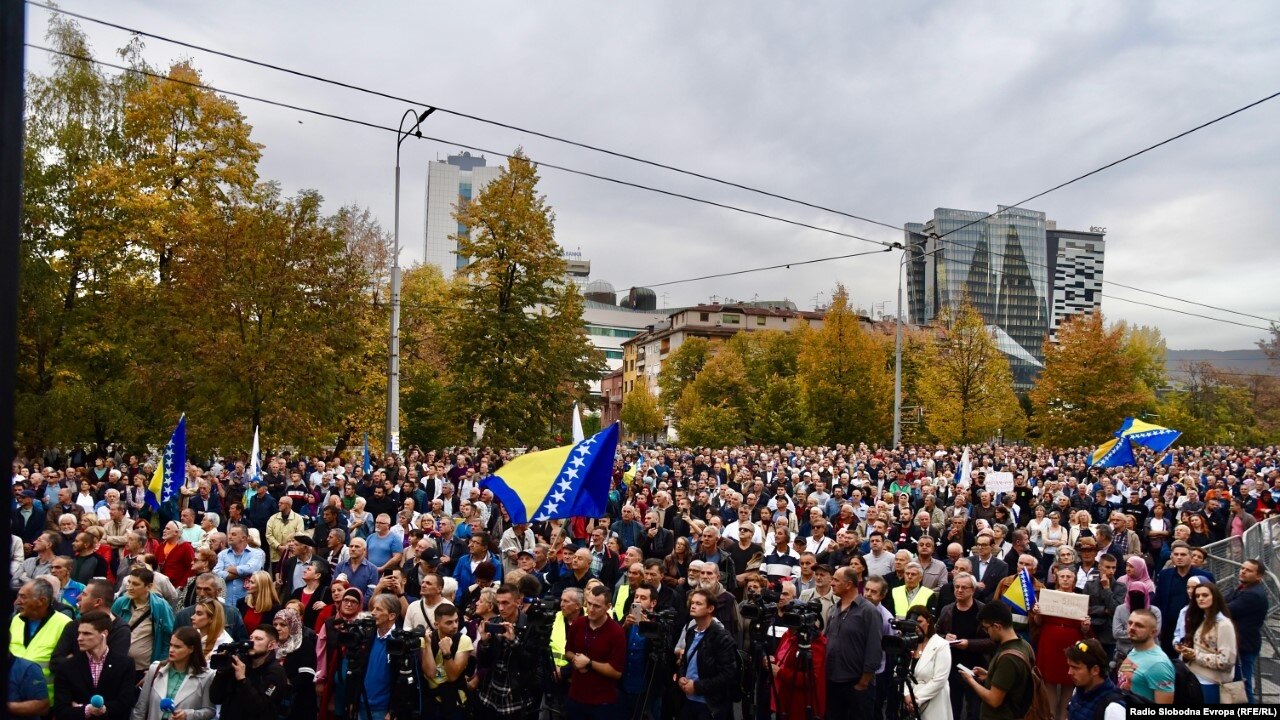
Protesti pred OHR-om nakon nametanja izmjena Izbornog zakona, oktobar 2022. (Foto: Radio Slobodna Evropa)
Kenan Efendić
05.06.2026. 09:54
The first category includes Milorad Dodik and his SNSD, followed by nearly all political parties from Republika Srpska and Dragan Čović's HDZ. Their ranks also include formal and informal lobbyists — among them former High Representatives and foreign diplomats. And, of course, the regional capitals: Belgrade and Zagreb.
Their argument runs as follows: the High Representative's interventions only deepen crises and divisions; it is unacceptable for a country to remain under some form of international tutelage three decades after the war; and political processes should be handed back to domestic actors.
Anxious Champions of Sovereignty
The second group is far more interesting and merits closer examination. Diverse and diffuse, it spans specific voices from the Bosniak right, a handful of rational voices from moderate Serbian nationalism in Banja Luka, and some rather restless figures from the domestic NGO scene.
They describe the OHR as a form of colonial administration, an unacceptable international protectorate in an era of democratic primacy, a lever of global power centres, an obstacle to authentic domestic consensus about the state.
These are valid — and probably well-intentioned — arguments. But they are nervously and inadequately articulated, and at times simply incorrect. The adjective colonial, for instance, cannot describe an arrangement that involves no settlement, no exploitation, and no annexation of territory to any external political entity.
However varied they may be, all these voices share a common note: they call for abolishing the OHR without offering any clear framework, conditions for implementation, concrete alternative, or analysis of how relations might evolve following such a structural break.
In that sense, their calls resemble the voice of an exasperated person who, caught in a tangle of interlocking grievances, seeks resolution by pulling what appears to be the simplest lever.
A Deficit of Political Wisdom
Often skipping past both the political and constitutional nuances of the OHR's establishment and the dynamics of its various operational phases, these voices routinely treat the OHR as a fixed point outside time and space. In such analyses, Bosnia and Herzegovina appears as some distant, potentially idyllic land that opportunistic foreigners — in concert with corrupt domestic elites — simply will not allow to thrive. The roses would bloom, the implication runs, if only the OHR were gone, and domestic politicians would be on hand to harvest them.
The OHR was established, and later strengthened with the Bonn Powers, precisely because domestic actors could not reach agreement in the immediate aftermath of the war. Relations are, of course, not as fraught as in the late 1990s. Yet the tenures of those High Representatives who chose not to intervene — Schwarz-Schilling, Lajčák, and Inzko — were precisely the period of deteriorating internal relations and the consolidation of forces for whom agreement is not an end goal but a pretext for indefinitely postponing one.
Relations deteriorate, in short, whether the OHR is passive or active. The mere fact of its existence — the possibility of intervention — has long been enough to deter destructive actors from taking radical steps. When they did take such steps, as Dodik did, and for which he was ultimately convicted, a response became unavoidable.
Dragan Čović challenges the OHR's authority even when its decisions work in his favour, because his and Dodik's ultimate objective is precisely a dysfunctional state. And dysfunction is the primary argument for partitioning or fundamentally reconstituting any state.
The problem, therefore, is not the OHR as such, but the relationships and the disposition of the forces that made it necessary. The voices of the second type of OHR abolitionists — whether by design or inadvertently — thus end up serving the forces that seek to dismantle the state.
Without Concrete Arguments
These demands are understandable. That does not make them reasonable. Their defining characteristic, in fact, is precisely their irrationality. They call nervously for a radical act while proposing no concrete steps toward it. From the well-intentioned abolitionists, one will not hear, for example, how the Viaduct case would be resolved without a High Representative, how elections would be organised in a year when the first group is deliberately blocking the state budget, or how to prevent institutional paralysis when parliamentary sessions are systematically boycotted.
Their calls cannot, therefore, be considered in isolation from those of the first kind. In politics, intentions do not count — moves and consequences do. The OHR can and should be abolished, but only once all domestic points of state paralysis have been neutralised. For now, the High Representative remains the only safeguard capable of doing so.
O autoru

Kenan Efendić
Glavni i odgovorni urednik portala !Odgovor. Radio kao novinar i urednik u nekoliko bosanskih i međunarodnih medija („Radiosarajevo“, CIN, OCCRP, „Balkan Insight“), te kao urednik i prevodilac u izdavaštvu i konsultant u neprofitnom i međunarodnom sektoru. Završio Gazi Husrev-begovu medresu, studije književnosti i jezika te komunikologije.
Više od istog autora