During a recent media interview for FTV Christian Schmidt appears to have all but confirmed that his tenure as High Representative is ending. Whether Schmidt leaves tomorrow, or in a year, is less relevant than the consequences of his departure for Bosnia and Herzegovina, and pro-Bosnian politics more precisely.
A New High Representative and Grand Bargain for Bosnia
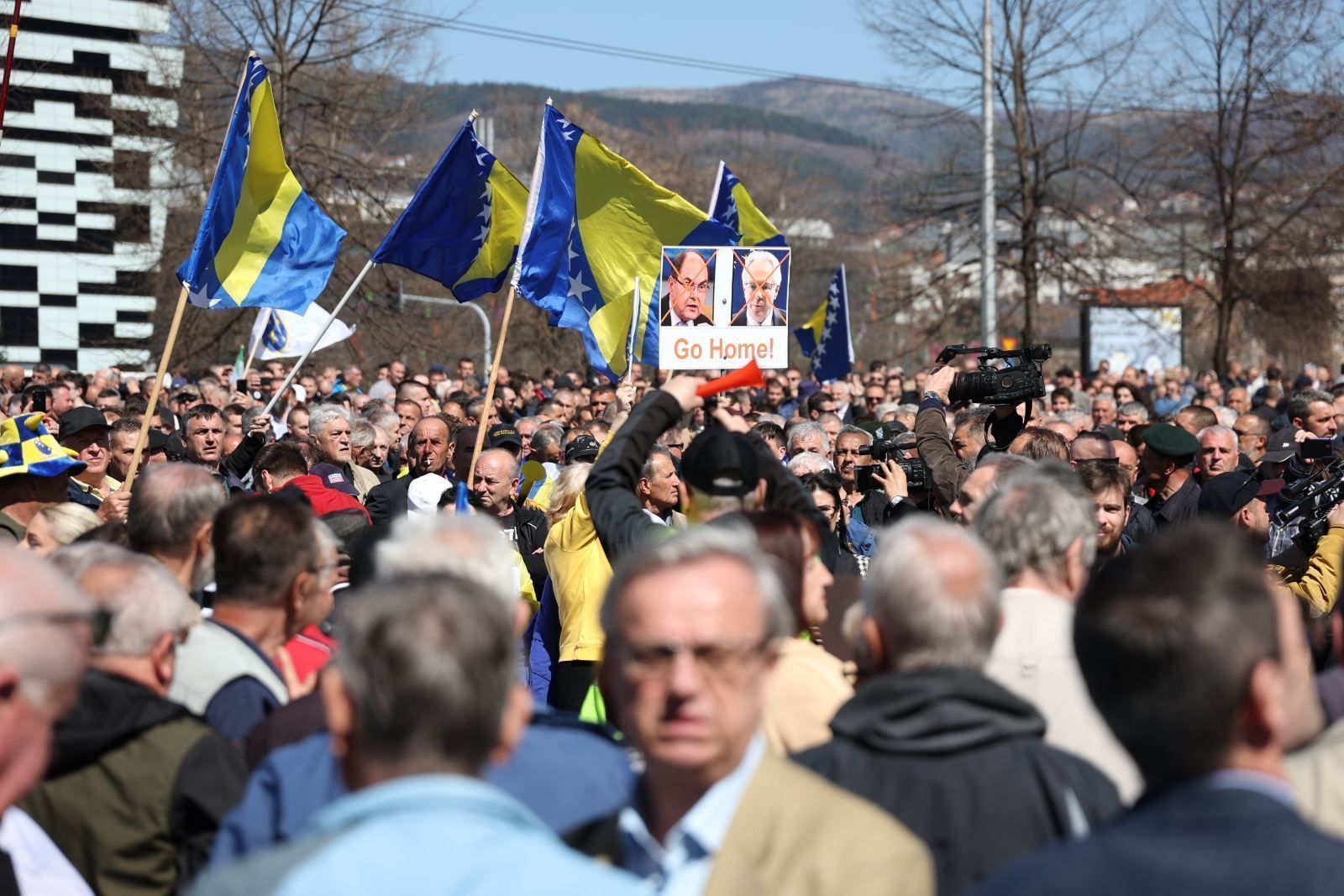
Nenanislni protesti građana pred zgradom OHR-a, juli 2021. (Foto: FENA)
Jasmin Mujanović
25.04.2026. 02:13
Specifically, what matters is the development of a coherent program by sovereigntist political actors in Sarajevo towards the question of Schmidt’s replacement, an agenda of demands of his successor, and a clearly articulated position towards the Office of the High Representative (OHR) as an institution, and how to achieve its closure.
It is not necessary to review the litany of criticisms leveled against Schmidt for his conduct since 2021. His bizarre behavior was ably laid out even in the German media. Suffice it to say, Schmidt’s transparent sympathies for the Croat nationalist establishment, and his deeply inappropriate illiberal interventions in the 2022 general elections (and the post-election government formation process in 2023) represented the nadir of the legitimacy of the OHR as an institution.
Realistically, Schmidt was a poor choice for High Representative to begin with. But his selection was engineered by the government of Andrej Plenkovic after nearly a decade of sustained lobbying in Berlin. And as Sarajevo did little to oppose that effort, Croatia was in effect pushing on an open door.
The damage Christian Schmidt has wrought to Bosnia’s EU and NATO aspirations by cementing the sectarian dimension of the country’s political system is significant and will not be easily repaired. But if it is to be repaired, it requires ensuring that the next High Representative will share none of Schmidt’s ideological views, nor his temperament.
To achieve that, sovereigntist political leaders in Sarajevo should offer an explicit ‘deal’ to the members of the Peace Implementation Council (PIC) Steering Board.
The Bosnian side should welcome Schmidt’s departure, and request that the next High Representative – ideally, a woman – should come from a member state whose government explicitly supports Bosnia’s accession to NATO and the EU through the realization of political and constitutional reforms in the country in line with the EU acquis, the decisions of the European Court of Human Rights, and the opinions of the Venice Commission.
The next High Representative should be given a mandate by the PIC to use their Bonn Powers to push the country towards those objectives but only through amendments to technical aspects of the country’s governance, not substantive alterations to Bosnia’s legislative or constitutional framework. That must remain the task of local governments and legislatures.
While it would be wonderful to wipe the slate clean of all of Schmidt’s interventions in Bosnia’s constitutional law, leaders in Sarajevo should not demand as much of the PIC. First, the international community will not support it, and secondly it would be damaging to the institutional integrity of the state to whipsaw from one government formation method to another.
Instead, the key demand by Bosnian sovereigntist leaders must themselves be technical: Schmidt’s April 2023 amendments to the constitution of the Federation entity should be amended to establish legal consistency in the government formation process in the entity moving forward. Namely, the government formation method explicitly authorized by Article 1 of the High Representative’s then decision – i.e. government is formed through the agreement of the President of the Federation and one vice-president, plus the support of the majority of the Federation entity House of Representatives – is made permanent.
The latter half of Schmidt’s decision, which inexplicably negated the right of future governing coalitions to repeat the methodology which he had explicitly authorized in April 2023, would thus be simply dropped. Everything else, including his (yes, illiberal) gerrymandering of the Federation entity election law from October 2022, would remain in place.
But this minor amendment to the April 2023 decision would significantly rationalize the government formation process in the Federation entity and allow for democratically legitimate amendments to the entity’s constitution and government formation methodology to take place through the legislative process in the future. It would also have a positive knock-on effect at the state level, due to the de facto symmetry that exists between state and entity-level governing coalitions.
In exchange for these commitments by the new High Representative and the PIC, the leadership of all pro-Bosnian parties with representation in the state parliament, and the two entity assemblies, would introduce omnibus legislation to (at minimum) appoint a Bosnian chief negotiator to formally begin accession negotiations with the EU; realize all outstanding aspects of Bosnia’s present EU Reform Agenda; and introduce corresponding legislation to resolve the state property dispute in line with the decisions of the country’s Constitutional Court.
The successful implementation of this program could be further incentivized (on both sides) through a sequence of intermediate goals.
For instance, once the new High Representative is appointed, and has amended the April 2023 decision, and the grand coalition of pro-Bosnian parties has introduced all the above legislation, and has subsequently secured its enactment into law, the OHR would announce that the formula for its closure – the 5+2 Agenda – has been realized.
As a result, the OHR would then move to suspend its operations by 2030. A corresponding international agreement would be made so that if the 5+2 Agenda is deemed to have remained implemented by 2035, the OHR would be terminated completely at that time (a process paralleling the sequenced settlement of the Brcko issue after the signing of the Dayton Agreement).
To ensure a safe and secure environment in Bosnia, and the Western Balkans, following the suspension and eventual termination of the OHR, the country would be admitted to NATO in the same window – i.e. between 2030 and 2035 – during which time the EUFOR mission in the country could also be concluded.
If all of this sounds a bit fantastical, it is because both officials in Sarajevo and the international community have lowered expectations for themselves and the country so low that an exercise in basic governance reads like science fiction.
The potential obstructionist role of the HDZ and SNSD in this entire process is also scarcely worth mentioning. If the combined 25% vote of the HDZ and SNSD bloc – a figure which is inflated due to the well-established pattern of voter fraud by both parties and the sum of which is on par with the population of the Zenica-Doboj Canton – is sufficient to derail all desire at progress by the overwhelming majority of Bosnians, and the geopolitical weight of the EU and/or US, then politics as such in Bosnia is moot.
That is not the case, however. All signs point to the arrival of a new High Representative, and another round of international attempts at charting a path forward in Bosnia. Leaders in Sarajevo must use that fact to their advantage, that is, the advantage of the country and citizens they claim to represent. But doing so requires at least articulating a set of political demands of international decision-makers – because power concedes nothing without a demand.
O autoru

Jasmin Mujanović
Jasmin Mujanović je bosansko-američki politolog, autor nekoliko knjiga.
Više od istog autora