No country, outside Hungary itself of course, will be as affected by the outcomes the Hungarian parliamentary elections on April 12 as Bosnia and Herzegovina. The reasons are simple: the government of Viktor Orban is the chief political and financial backer of the secessionist regime in Banja Luka, and Orban’s patronage of Milorad Dodik has been instrumental in keeping the long-time Serb nationalist radical, and his inner circle, free of EU sanctions.
Orban’s Defeat is a Historic Opportunity for Progress in the Western Balkans
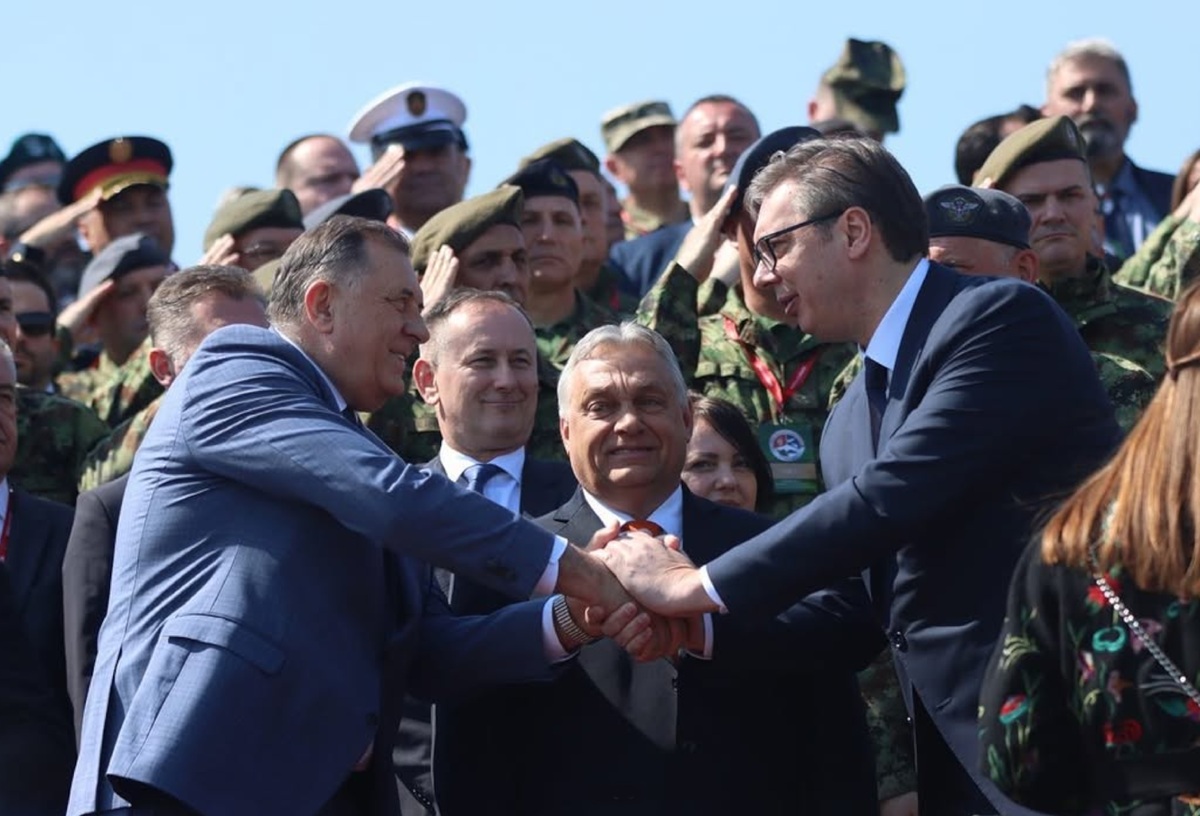
Dodik, Orban, Vučić. (Foto: Milorad Dodik / Instagram / Atlatszo.rs)
Jasmin Mujanović
08.04.2026. 05:41
But even if Orban and his Fidesz party are ousted from power in Budapest, no one should expect a transformation overnight, in Hungary or the region. To realize the full potential of a new security architecture in Southeastern Europe that may be constructed with Orban’s defeat, significant political recalibration will be needed. Because Hungary’s elections may be the most significant plebiscite in Europe in a generation a far broader reckoning in Brussels and the capitals is needed.
Because Orban’s capture of the both the Hungarian and European security and political apparatuses over the sixteen years of his tenure as Prime Minister required a legion of enablers and allies. Fidesz (re)created a veritable one-party regime in Hungary, and staffed all key political and administrative positions, including those within the EU, with loyalists. Orban and his inner circle may fall but their soldiers will remain.
Concerning Hungary’s hitherto malign presence in the Western Balkans, there are three key priorities to focus if Fidesz loses power on Sunday.
First, the EU should not rush to normalize ties with any new government in Budapest. Péter Magyar’s potential victory should, of course, be welcomed. But even Hungarian journalists have warned that they do not anticipate immediate improvements to the country’s media environment.
Still, Orban’s defeat would be an opportunity to at least scale back Hungary’s influence in the Western Balkans, something that must be clearly requested of the new government in Budapest by Brussels and relevant capitals. At least until it can be assured that the era of Orban’s support for Serb secessionism in Bosnia, for instance, has fully concluded.
That also necessarily means ejecting Hungary from the EUFOR mission in Bosnia, so too the KFOR mission in Kosovo, and establishing a cordon sanitaire around any further Hungarian involvement in any EU or NATO operations related to the region for at least a decade. Hungary’s ejection from EUFOR and KFOR should be pursued even if their troops cannot be replaced by another allied force. It is better to have a smaller EUFOR and KFOR presence in Bosnia and Kosovo respectively without any Hungarian soldiers, than a larger force with the presence of those Hungarian boots. Especially given Hungary’s direct involvement in recent efforts to secure the illegal extraction of (then fugitive) Milorad Dodik from Bosnia.
Second, any opening in the Western Balkans afforded by Orban’s defeat must be quickly seized to push on his regional allies. Serbia’s involvement in the transparent false flag operation near the gas pipeline in Kanjiza is an obvious place to start. There can be no question now that Serbia’s government has been working directly with the Orban regime, and one assumes their Russian counterparts, to undermine a free and fair electoral process in that country. In other words, Belgrade is directly interfering in the internal democratic deliberations and security of an EU member state, and therefore the EU itself. That must result in meaningful political consequences for Serbian President Aleksandar Vučić: the suspension of the country’s EU accession process, for example, or at the very least the termination of EU development funds to Serbia.
Sanctions against Dodik and the broader secessionist regime in Banja Luka must also be a priority. The same will likely remain opposed by the HDZ government in Zagreb and the Fico government in Bratislava but without the political cover afforded to them by Orban they are also far more likely to accede to a sustained pressure campaign by determined advocates. Moreover, EU sanctions will also greatly aid the prospects of an opposition victory at Bosnia’s general elections later this year, potentially ushering in the end of more than two decades of SNSD rule in the RS entity, and the accompanying crippling of all meaningful reform initiatives in Bosnia as a whole.
Assuming the EU can muster sufficient political mettle to realize these objectives, there is a third policy priority that Brussels and the capitals should pursue in the Western Balkans to ensure that any future return to power by Orban (which should not be foreclosed as a possibility) will be limited in its regional effects. Namely, the EU should seek to rollback the scale of Hungarian commercial involvement in the regional energy and media markets. This is especially pressing with respect to MVM and MOL’s presence in Serbia’s energy industry, but also the ventures of Orban-linked firms Veolia, MBM, and Alteo in Bosnia. It may not be possible to scuttle all these projects in short order, but Brussels and the capitals should make it a priority to minimize their regional presence all the same.
Nor should officials in Sarajevo expect their European counterparts to do all the heavy lifting. To achieve any of these aims will require a clearly articulated set of demands from the Bosnian presidency and Ministry of Foreign Affairs; lower levels of government, including individual cantons, should also be tapped, as needed, to drum up diplomatic pressure on the EU to act. With respect to the Hungarian presence in Serbia, a joint front with Kosovo and Montenegro, both of which have a shared interest in seeing Russian-aligned actors pushed out of the region, should also be pursued by Bosnian officials.
Above all, this is a moment that cannot be squandered by anyone genuinely committed to the security and democratic cohesion of Europe or the Western Balkans. Viktor Orban’s illiberal regime should never have been allowed to so severely infect the whole of the Euro-Atlantic body politic. Now that there is, at long last, an opportunity to purge this toxin, it will require coordination and courage by leaders in Brussels, Sarajevo, and elsewhere to make the remedy stick.
O autoru

Jasmin Mujanović
Jasmin Mujanović je bosansko-američki politolog, autor nekoliko knjiga.
Više od istog autora