The joint U.S.-Israeli strikes against Iran, and the ensuing chaos in the Persian Gulf, have triggered the most significant global political crisis since Russia’s 2022 (re)invasion of Ukraine. It has rattled global equity and energy prices, while the scale of destruction which now stretches from Teheran to Erbil to Abu Dhabi, and beyond, is already measured in the hundreds of billions of dollars and rising.
Ideology vs. Geography: Sarajevo sits far closer to London than Teheran
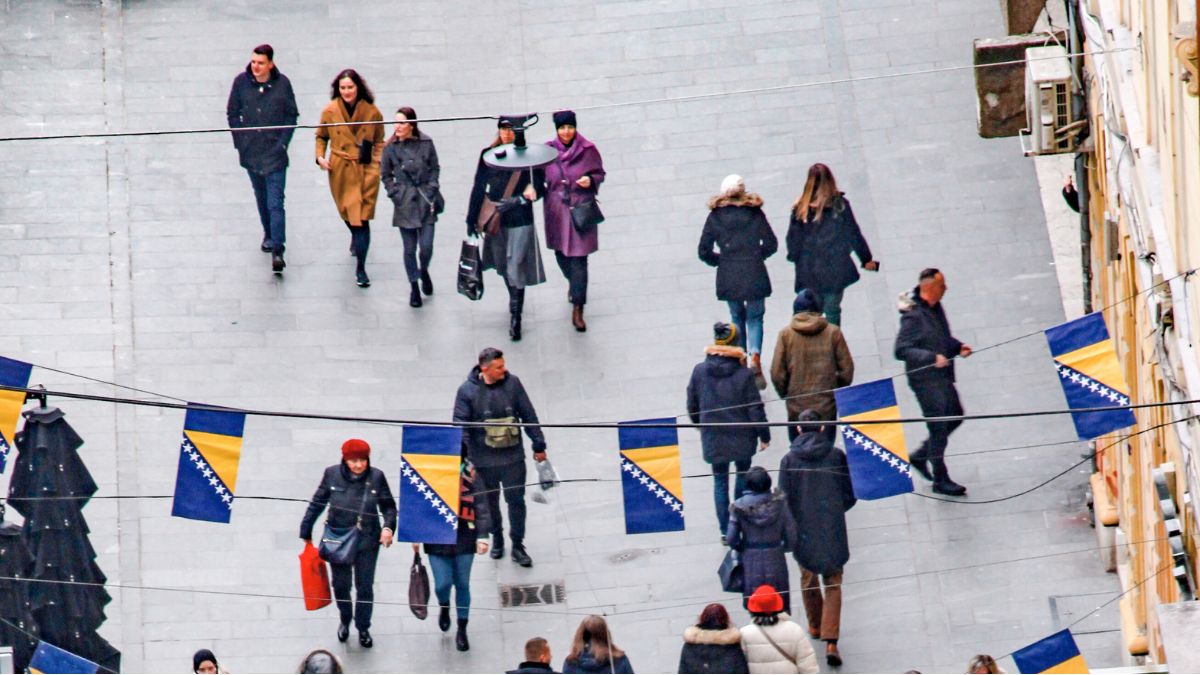
Foto: Emir Isović / Fotobaza
Jasmin Mujanović
14.03.2026. 04:33
The potential implications of this conflict are legion. It is, certainly, a reflection of the inevitable tragedy of authoritarianism. It may also be a worrying illustration of the limits of American hard power, which will be carefully – and gleefully – deconstructed in Beijing and Moscow.
What, if anything, are the lessons for the Western Balkans of this conflict?
That some regional capitals have lined up behind the U.S. and Israel, while others have remained largely indifferent is hardly news. Both the silence and support of Western Balkan states, in this respect, is largely performative. Their collective influence on Middle Eastern affairs, and American and Israeli interests therein, is virtually non-existent.
Why then are there so many efforts underway (readily visible through (social) media) to link events in the Middle East with the politics and security of the Western Balkans?
To begin with, it is because Islamophobia has long been a central feature of Serb and Croat nationalist propaganda against Bosniak (and Albanian) communities. And in that context spurious connections to the Middle East have been a key feature of these narratives. Narratives which are impervious to facts because they are purely ideological constructs aiming to dehumanize and delegitimate Bosniaks and Albanians as a (predominantly Muslim) people, and their indigeneity to the Western Balkans.
So, one might observe, for instance, that Bosnia and Herzegovina is the freest Muslim-majority state in the world, according to the DC-based libertarian Cato Institute, and that its capital Sarajevo routinely hosts Pride marches, film and literary festivals, and all manner of robust public discourse and debate. Or one might note that evidence of Jewish life in Bosnia dates to the Roman period, possibly preceding the arrival of Islam in the country by hundreds of years, and that as a recent Times of Israel article concluded “There are forty-nine people from Bosnia and Herzegovina listed by Yad Vashem as Righteous Among the Nations, twenty-eight of these were Bosniak...The social ties between Jews and Muslims in [Bosnia]…are remarkable.”
But the exercise is fruitless.
As I wrote in The Bosniaks “From the Serb and/or Croat nationalist perspective, the Bosniak can never be genuine in…his embrace of liberalism because the Bosniak is, by definition, deceitful and dangerous.” The parallels being drawn between this local sectarian perspective and historic forms of antisemitism are intentional and entirely warranted.
But as with antisemitism, it is precisely because these arguments are spurious – not least because there is an obvious, enormous geographic distance between the Balkans and the Middle East –that it needs to be made, and made again, and again, in the hope that the sheer frequency of absurd claims will supplant the poverty of their merits.
That is how, for instance, a Sarajevo urban renewal project known as the “Green Transversal” (i.e. the Zelena transferzala or Zetra)first conceived by the celebrated architect Juraj Neidhardt and eventually realized through the construction of the Zetra sports hall ahead of the 1984 Winter Olympics, became the subject of a fantastical but illustrative Serb nationalist conspiracy theory.
Namely, Miroljub Jevtić’s 1989 Modern Jihad as War, an instant national bestseller in Serbia at the time of its publication, argued, inter alia, that the Zelena transferzala was, in fact, an attempt to create an Islamist land corridor between Muslim-majority territories in the Western Balkans and Turkey. How exactly this corridor was going to pass through North Macedonia, Greece, or Bulgaria, or what it had to do with air pollution, or figure skating was never quite explained.
Of course, to adherents that has never been the point.
Because the purpose of this narrative was not to produce evidence of Islamist activism in Bosnia or the Balkans but to justify violence against Bosniaks and Muslims in the region. Which, of course, is precisely what ensued in 1992. Today, those who recycle similar conspiracies, including recent articles in tabloids like the Washington Times (the mouthpiece of a literal cult) remain unmoved by the facts.
Like the fact that it is Serbia has been quietly increasing its political and defense cooperation with Iran since at least 2022, or that the United Arab Emirates abstained from the supporting the UN Srebrenica Genocide resolution in 2025, likewise because of its close ties to the Belgrade regime. As did several other majority Muslim states like Bahrain, Algeria, Lebanon, Oman, and Sudan.
Ironically, the reservations of these Muslim-majority states to recognize the most significant pogrom of a Muslim-majority people in the second half of the 20th century, and in Europe no less, reflects the core element of truth in this moment of frenetic international jousting.
There is no clash of civilizations; there are, as there have always been, only the competing interests of states. And these make strange allies and adversaries. For governments in the Western Balkans then, the events in the Middle East should only be relevant insomuch as they advance or hinder their respective sovereign interests.
For Bosnia and Herzegovina, for instance, its long-term strategic trajectory remains clear: the rationalization and democratization of its constitutional regime, which will allow for its eventual entry into NATO and the EU, which are priorities, chiefly, because they are bulwarks against the political and territorial pretensions of its neighbors.
The public, of course, may have its views and sympathies. And they may use the democratic process to influence the decisions of their governments. But no vote, nor protest, nor ideological conviction, whether malign or sympathetic, can change basic geographic facts. Sarajevo sits far closer to London than Teheran, much as it is closer to Berlin than Ankara. Its leaders must begin and end the consideration of every major decision on those terms.
O autoru

Jasmin Mujanović
Jasmin Mujanović je bosansko-američki politolog, autor nekoliko knjiga.
Više od istog autora