While the regime of Bosnian Serb, Russian-backed leader Milorad Dodik once again seeks to advance its separatist objectives—this time through a new wave of Islamophobia openly framed in “Christian values”—in practice, the Republika Srpska entity, a part of the sovereign state of Bosnia and Herzegovina, freely and discriminatorily functions as an exclusive community of Orthodox Christians.
The Politics of Endangered Christians and the Exclusion of Non-Orthodox Citizens
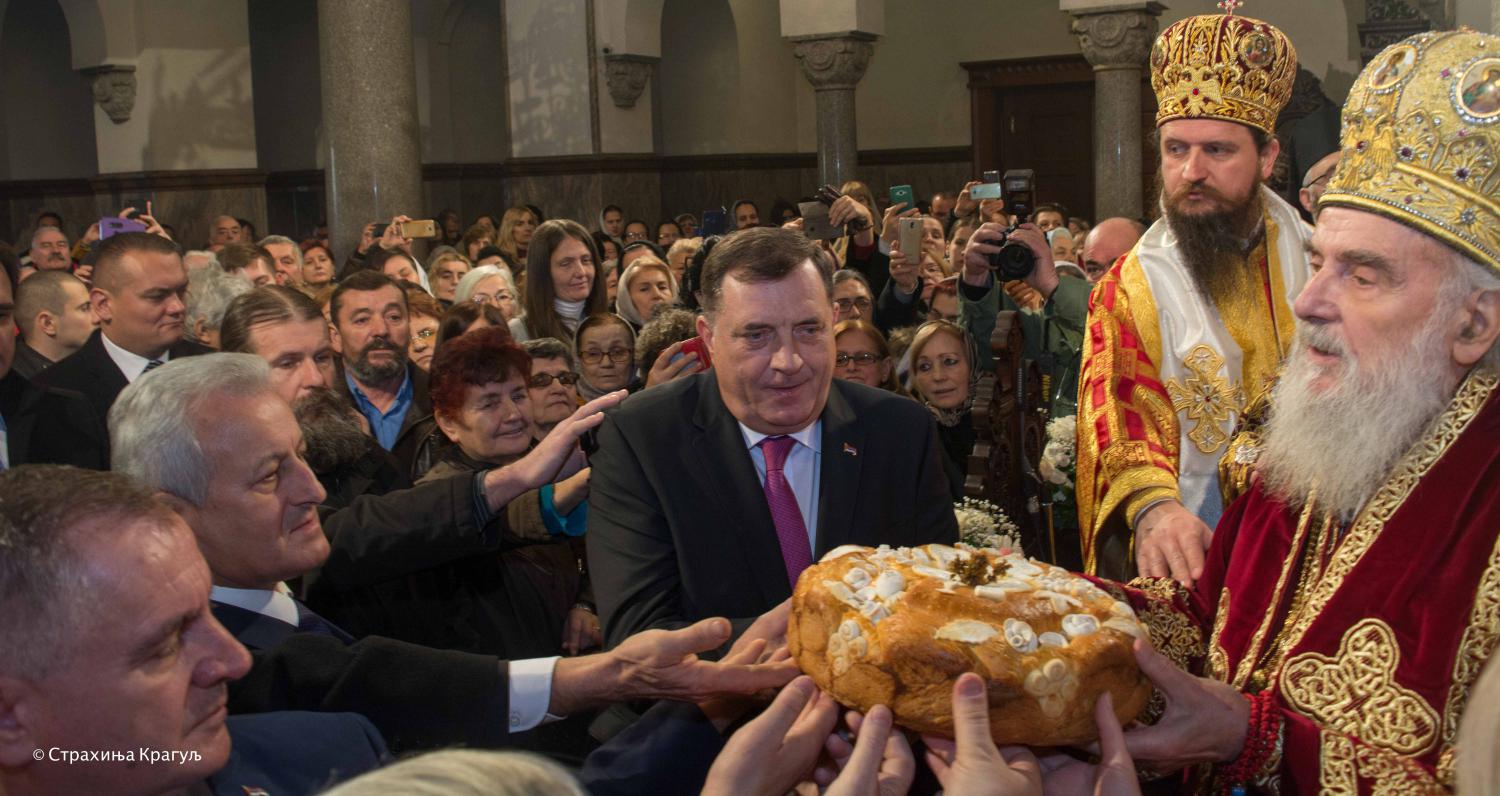
The Entity’s Slava, January 9, 2019. Milorad Dodik, other officials, and Patriarch Irinej of the Serbian Orthodox Church. (Photo: SPC)
!Odgovor
12.02.2026. 09:57
The celebration of krsna slava, an exclusively Serbian Orthodox custom, is embedded in the institutional calendar of Republika Srpska—the very entity that Milorad Dodik seeks to separate, claiming it is endangered because it is “Christian” and allegedly threatened by Muslims.
In reality, this predominantly Serbian, Orthodox entity, as an administrative unit, discriminates against and excludes not only Muslims, but also Catholics, Jews, and other communities.
The Entity’s Slava Is Unconstitutional and Illegal
Krsna slava is a specific Serbian and Montenegrin cultural and religious tradition. It consists of family celebrations linked to the day of a particular Christian saint in the Orthodox calendar.
Alongside Christmas and Easter, slavas are, in essence, the most important religious holidays for Orthodox Serbs and Montenegrins. The Republic of Serbia has designated slava as intangible cultural heritage, while the United Nations cultural organization, UNESCO, added it to the World List of Intangible Cultural Heritage in 2014.
The most widely celebrated one is St. Nicholas (Nikoljdan), observed on December 6.
Bosnia and Herzegovina is a secular state, and Republika Srpska, as its constituent administrative unit, is obliged—under both the state Constitution and its own Constitution—to treat all citizens and members of the constituent peoples equally. In practice, however, the example of institutionalized slava celebrations shows that RS has effectively been cemented as a Christian, Orthodox political community.
The entity itself marks its slava on January 9, the feast of St. Archdeacon Stephen, which coincides with the unconstitutional “Day of Republika Srpska.” The non-secular character of this holiday was, among other factors, the basis on which the Constitutional Court of Bosnia and Herzegovina repeatedly declared it discriminatory and banned its observance.
Political and legal disputes surrounding this unconstitutional holiday and slava have become Milorad Dodik’s main maneuvering ground for separatist initiatives over the past decade.

Slavas for Ministries, Schools, Municipalities, and Public Companies
The Ministry of Interior of Republika Srpska—whose employees include Muslims, Catholics, and others (although in significantly smaller numbers than legally required)—celebrates St. Archangel Michael (Aranđelovdan) on November 21.
All schools in RS observe a school slava on St. Sava’s Day. Municipalities and cities, as units of local self-government, also mark their own slavas: Banja Luka—Spasovdan (40 days after Easter), East Sarajevo—St. Peter of Dabar-Bosnia (September 17), and Bijeljina—St. Panteleimon (August 9).
Even public companies maintain their own slavas. For example, the municipal utility company in Ugljevik celebrates the Nativity of the Virgin Mary (Mala Gospojina). State-owned Electric Utility Company of the RS does not have a single unified slava, but its subsidiaries and affiliated companies do: Elektro Bijeljina—St. Elijah; Hydropower Plants on the Drina—St. Sava; Gacko Mine and Thermal Power Plant—Sts. Cyril and Methodius.
Tolerating Discrimination for the Sake of Stability
In all of these celebrations—from the highest level, including the Day of Republika Srpska, to local events—priests of the Serbian Orthodox Church take part.
Through this practice, Catholics, Muslims, and members of other religious communities in Republika Srpska are directly excluded and discriminated against.
At the same time, public institutions, companies, and schools in parts of Bosnia and Herzegovina where Muslims (predominantly Bosniaks) and Catholics (predominantly Croats) form the majority do not observe religious holidays in their institutional capacity.
Although the Constitutional Court has challenged this form of holiday observance, other political actors and national groups in Bosnia and Herzegovina have, after thirty years of Dayton-era Bosnia and Herzegovina, accepted this form of discrimination and largely tolerate it in the name of political stability.
O autoru

!Odgovor
Svjesni da je živi dijalog istinski ravnopravnih sagovornika temelj razumijevanja i postizanja općeg dobra, platformu nudimo svim zainteresiranim autorima, organizacijama i grupama koje dijele naše osnovne ciljeve.
Više od istog autora